
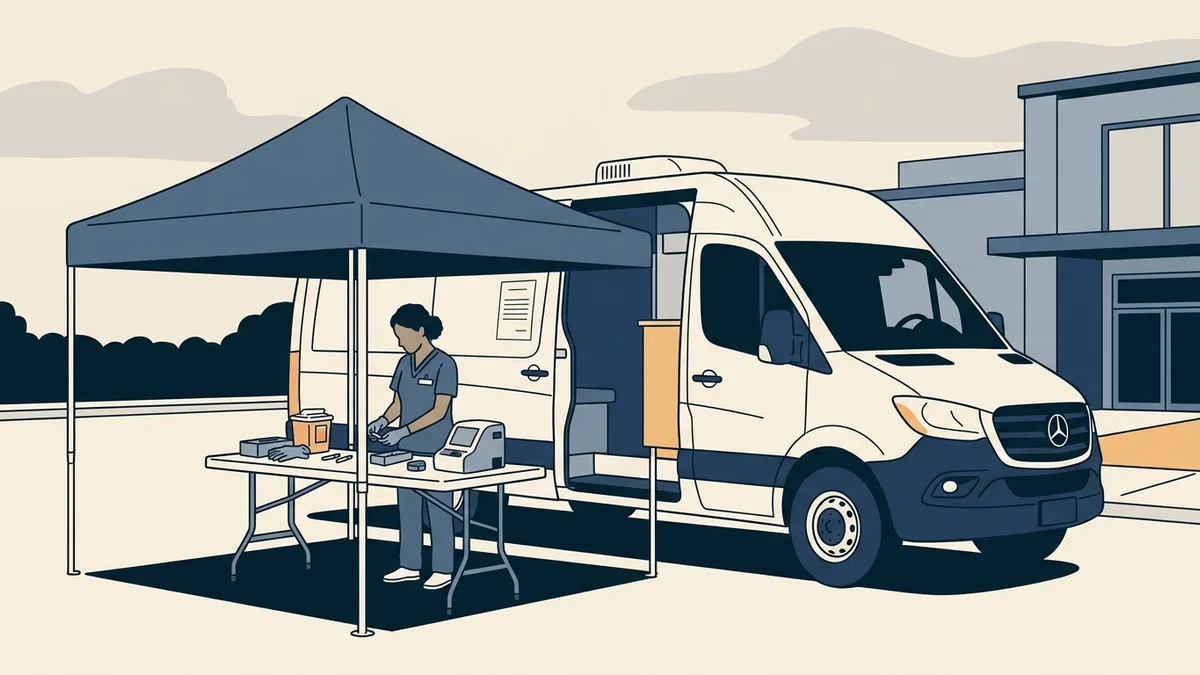
Mobile units, health fairs and other temporary testing locations can run under one CLIA certificate held by a home base, using its address, under 42 CFR 493.35(b)(1). The CMS-116 must list the temporary sites and attach the VINs of any mobile units. A vehicle that only transports equipment is not a mobile unit.
Fixed sites need one CLIA certificate each. Testing that moves is the one place a for-profit organization can legitimately put many testing locations under a single certificate. The first exception in the federal rules reads: "Laboratories that are not at a fixed location, that is, laboratories that move from testing site to testing site, such as mobile units providing laboratory testing, health screening fairs, or other temporary testing locations may be covered under the certificate of the designated primary site or home base, using its address" (42 CFR 493.35(b)(1); the same wording appears at 493.43(b)(1) and 493.55(b)(1)).
CMS counted 2,588 mobile labs and 527 health fair labs in September 2026 (CMS laboratory statistics). They range from a single screening van to statewide programs.
What counts as a mobile unit?
CMS defines it narrowly. "A mobile unit is generally considered to be a movable, self-contained operational laboratory with its own personnel, equipment, and records, with equipment installed and located permanently within the mobile unit" (State Operations Manual, Chapter 6, section 6010.1). The CMS-116 instructions use the same definition for facility type 19, Mobile Laboratory.
A vehicle that only carries equipment does not qualify: "If a vehicle is used solely to transport laboratory equipment from the primary site/home base to another site where testing is performed, the transporting vehicle is not a mobile unit." That vehicle is not a lab at all. The testing happens at the destination, which is a temporary testing site under the home base's certificate.
Where does a temporary site end and a fixed site begin?
A place the lab tests at for a limited time and then leaves: a health fair, a community screening event, a worksite visit, a patient's home. The regulation names "health screening fairs, or other temporary testing locations" and does not set a maximum duration. A location the organization tests at on a standing basis, such as a clinic open every week at the same address, starts to look like a fixed site, and fixed sites need their own certificate. Ask your State Agency where a recurring schedule crosses that line.
Which sections of the CMS-116 change?
- Section I: the home base's name and physical address, which "cannot be a Post Office box."
- Section III: the facility type of the home base, or 19 for a self-contained mobile lab, or 10 for a health fair.
- Section V: answer "Yes" to applying for one certificate across multiple testing locations and "Yes" to the first exception. "A list of temporary testing sites must be included on or attached to the Form CMS-116. If a mobile unit is providing the laboratory testing, record the vehicle identification number(s) (VINs) and attach to the application."
- Section IV: testing hours, with additional sites attached "using the same format."
- Section VI: the waived test table covering every test run at any site, and the estimated annual volume for all of them.
For testing in patients' homes, "no individual addresses need to be submitted but should be available upon request" (SOM section 6016.1). The owner or director signs, and the form goes to the State Agency where the home base sits.
After approval, what does the State Agency expect?
CMS's guidance asks each mobile lab to give the State Agency "the primary site/home base or central dispatch phone number, so that the SA can obtain an updated schedule of the location(s) of testing and the hours of operation." Two record-keeping rules follow:
- "Records may be maintained in the mobile vehicle or at the primary site/home base."
- "Reports should reflect the primary site/home base address and indicate which mobile unit performed each test." The VIN can be used to tell vehicles apart.
When the list changes, the lab sends written notice: CMS lists "Changes to Multiple Site Information," including "changes... to the number or location of temporary testing sites," among the changes reported in writing. Adding the exception to a certificate that did not have it takes a new CMS-116 (SOM section 6016.1). A waiver lab running only waived tests may be inspected at any time during testing hours, wherever that is (42 CFR 493.1775), so the schedule you give the State Agency has to be real.
Why do mobile programs get into trouble?
- Combining exceptions. "Each exception stands alone and must not be combined with another exception" (SOM section 6010). A mobile program cannot also use the public health exception to add fixed clinics.
- Treating fixed clinics as temporary. A for-profit group cannot call its storefronts temporary sites to avoid separate certificates. See one certificate per site.
- Crossing state lines. "If a mobile laboratory operates in more than one State, CMS determines which state should perform an inspection." State licensing still applies wherever you test.
- Testing beyond the certificate. A waiver home base covers only waived tests at every stop. A screening van adding a moderate complexity analyzer needs a nonwaived certificate first.
How do states treat screening events and mobile testing?
- California mirrors the federal exception: mobile units, health fairs and temporary sites "may apply for and obtain one license or registration for the designated primary site or home base, using the address of that primary site" (Bus. & Prof. Code 1265(d)(1)).
- Maryland excludes temporary screening from its simplest route: "A person operating a temporary medical laboratory to perform health awareness tests, regardless of testing site location, is not eligible for a letter of exception" (COMAR 10.10.03.02). See Maryland.
- Rhode Island exempts "Any temporary or ad hoc health promotion or screening program conducted for the general public that offers generally accepted mass-screening procedures," but only when run "pursuant to a permit issued by the department of health" (R.I. Gen. Laws 23-16.2-3(2)).
- Maine exempts "Laboratory services performing health screening tests as defined and regulated by rule," naming cholesterol and colon cancer screening as examples (22 M.R.S. 2013-A(1)(G)).
How do we set up a mobile or event testing program?
We prepare the home base CMS-116 with Section V, the temporary site list, the VIN attachment and a test menu built from each kit's instructions, plus any state registration or event permit. Your owner or director signs, and you pay CMS on pay.gov. A Certificate of Waiver Application is $399 for the home base, and adding the exception or new vehicles to an existing certificate is a $149 CLIA Change Request. Renewal and Compliance Tracking ($299 per year) keeps the site list and notices current. For the certificate basics, see the Certificate of Waiver, start to finish.
Common questions
- Does each health fair need its own CLIA certificate?
- No. Health screening fairs and other temporary testing locations can be covered under the certificate of the home base, using its address, if the CMS-116 lists the temporary sites.
- Is a car that carries our analyzer to events a mobile lab?
- No. CMS says a vehicle used solely to transport equipment is not a mobile unit. The event location is a temporary testing site under the home base's certificate.
- Do we report every new event location?
- Changes to the number or location of temporary testing sites are reported to the State Agency in writing. For testing in patients' homes, individual addresses are not submitted but must be available on request.
- Can a mobile program also use the public health exception?
- No. CMS says each multiple-site exception stands alone and must not be combined with another.
Need Help with Your CLIA Certificate?
We prepare your CMS-116 and any state filing for your owner or director to sign, then track your certificate, changes and renewals.