
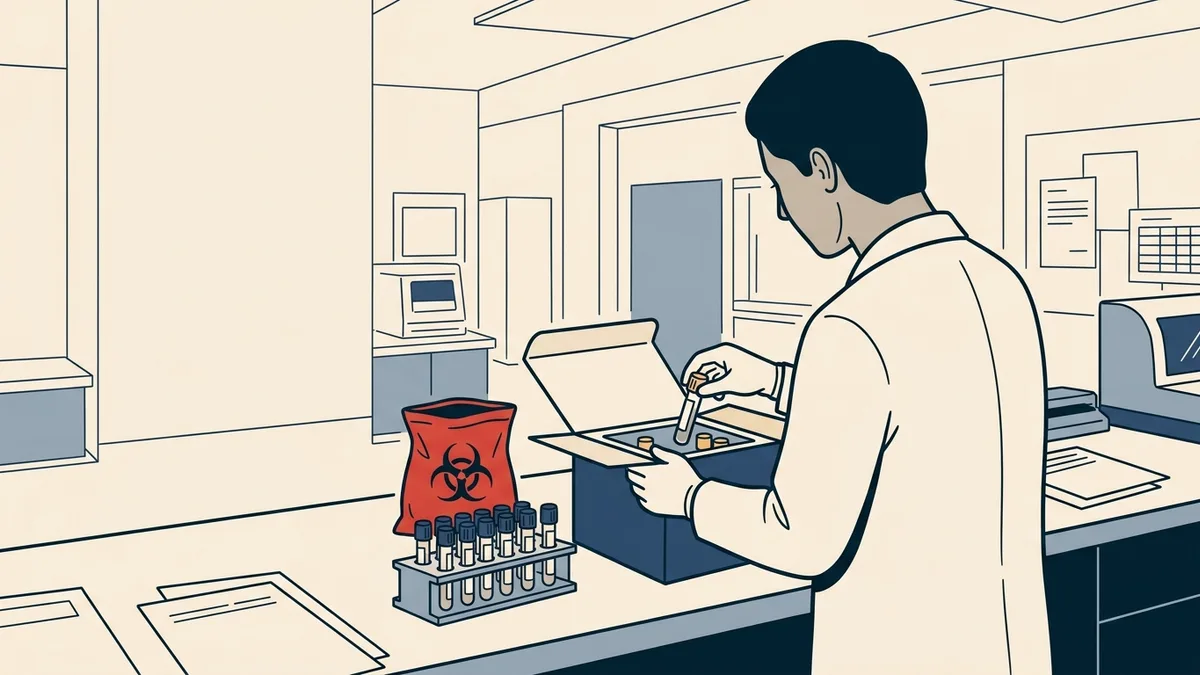
Nonwaived labs must enroll in a CMS-approved proficiency testing program for each specialty and subspecialty they are certified in and test the samples exactly like patient specimens, by their usual staff and methods. Failing the same analyte in two of three events is unsuccessful. Intentionally referring samples elsewhere can mean at least a one-year revocation.
Proficiency testing, or PT, is the external check on a nonwaived lab's accuracy. An approved program ships samples whose answers the lab does not know; the lab tests them like patient specimens and reports results; the program grades them. CMS's memo on the 2023 CLIA rule describes it as "the testing of unknown samples sent to a laboratory by an HHS-approved PT program to check the laboratory's ability to determine the correct testing results."
It does not apply to waived testing. Subpart H is titled "Participation in Proficiency Testing for Laboratories Performing Nonwaived Testing," and 493.20(c) says the proficiency testing condition is "not applicable to the waived tests."
Who has to enroll?
Each lab performing nonwaived testing "must enroll in a proficiency testing (PT) program that meets the criteria in subpart I of this part and is approved by HHS," in "an approved program or programs for each of the specialties and subspecialties for which it seeks certification" (493.801). The lab must:
- tell HHS which approved programs it uses;
- if it uses more than one, designate which program covers each specialty, subspecialty and analyte or test;
- stay with a program for one year before switching, and notify CMS before any change; and
- authorize the program to release its results to HHS (493.801(a)).
Approved programs must provide "at least three testing events" to the lab "at approximately equal intervals per year" for the regulated analytes in subpart I. For tests that subpart I does not list, the lab must verify accuracy "at least twice annually" by other means (493.1236(c)).
How must PT samples be handled?
"The laboratory must test the samples in the same manner as patients' specimens" (493.801). The rules spell out what that means (493.801(b)):
- Test them "with the laboratory's regular patient workload by personnel who routinely perform the testing," using routine methods.
- Test them the same number of times as patient samples are tested.
- Do not discuss results with any other lab, or between your own sites, until after the program's reporting deadline.
- Do not send PT samples, or any portion, to another lab for an analysis the lab is certified to perform itself.
- Document each step from handling to reporting, and keep the records, including the attestation signed by the analyst and the director, for at least two years.
Each program's report form carries an attestation "that proficiency testing samples were tested in the same manner as patient specimens," signed by the person who tested and by the laboratory director (493.901(c)(5)).
What counts as unsuccessful?
A single bad event is unsatisfactory performance. Unsuccessful participation is a pattern, defined in 493.2 as, among other things, unsatisfactory performance "for the same analyte in two consecutive or two out of three testing events," or repeated unsatisfactory overall scores for a specialty or subspecialty on the same basis. Labs must successfully participate for each specialty, subspecialty and analyte or test they are certified for (493.803(a)).
For a first unsuccessful performance, CMS "may direct the laboratory to undertake training of its personnel or to obtain technical assistance, or both, rather than imposing alternative or principle sanctions," unless there is immediate jeopardy, the lab cannot show it has corrected the problem, or it has a poor compliance history (493.803(c)). Otherwise, sanctions follow under subpart R. A Compliance lab also pays for a desk review of unsuccessful performance (493.643(d)(4)).
Why is PT referral treated so seriously?
Because it defeats the point. If CMS finds a lab "intentionally referred its proficiency testing samples to another laboratory for analysis," the consequences under 493.1840(b) are among the heaviest in CLIA:
- For a repeat referral, or where the lab reported another lab's results as its own before the event closed: revocation of the certificate for at least one year, a ban on the owner and operator owning or operating a CLIA lab for at least one year, and a possible civil money penalty.
- Where the lab obtained another lab's results before the event closed in other cases: suspension or limitation for less than a year, plus alternative sanctions that "will always include a civil money penalty and a directed plan of correction that includes required training of staff."
A lab that receives a PT sample from another lab must report it to CMS (493.801(b)(5)). The 2023 rule's alternative-sanctions change for waiver labs was described by CMS as "particularly useful in instances in which we find PT referral violations." See CLIA sanctions.
How does PT fit with the rest of a nonwaived lab?
The director must make sure the lab is enrolled, samples are tested as required, results are returned on time, reports are reviewed, and "an approved corrective action plan is followed" when results are unacceptable (493.1407(e)(4), 493.1445(e)(4)). Inspectors may ask the lab to test PT samples during a survey (493.1773(b)(1)). Accredited labs must also authorize their PT program to share results with their accreditation organization (493.551(b)).
Where does White Glove CLIA stand on PT?
Outside it. Proficiency testing samples belong to the lab and must be tested by its own staff with its own methods; we never receive, handle, test or forward them, and we do not advise on PT results. What we do is the certificate paperwork around a nonwaived lab, such as the CMS-116 for a change in certificate type and the director's qualification documents (Nonwaived Certificate Application Packet, $1,499; see pricing). For the full picture of going nonwaived, read moving from a waiver to moderate complexity testing.
Common questions
- Do CLIA waived labs need proficiency testing?
- No. Subpart H covers labs performing nonwaived testing, and 42 CFR 493.20(c) says the proficiency testing condition does not apply to waived tests. Waiver labs must still follow manufacturers' instructions.
- How many proficiency testing events are there each year?
- Approved programs must provide at least three testing events at approximately equal intervals per year for the regulated analytes. For tests not on the subpart I list, labs verify accuracy at least twice a year by other means.
- What happens if a lab sends a PT sample to another lab?
- Intentional referral can lead to revocation of the CLIA certificate for at least one year and a one-year ban on the owner and operator, plus a possible civil money penalty, under 42 CFR 493.1840(b).
- Who signs the proficiency testing attestation?
- The person who tested the samples and the laboratory director, attesting that the samples were tested in the same manner as patient specimens.
Need Help with Your CLIA Certificate?
We prepare your CMS-116 and any state filing for your owner or director to sign, then track your certificate, changes and renewals.