
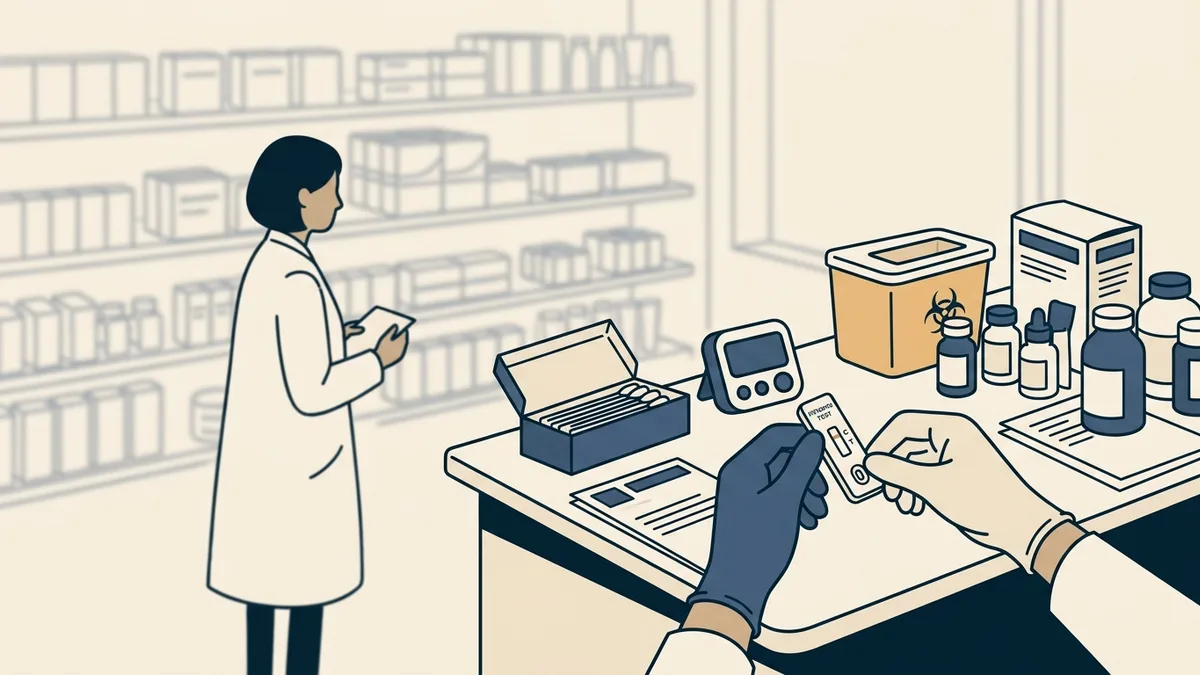
In New York, a site running only waived tests or PPM procedures that is not a practitioner-owned physician office registers with the Wadsworth Center's Clinical Laboratory Evaluation Program as a Limited Service Laboratory. The registration costs $200 per location every two years, lists the only tests the site may run, and is void after a change of owner or location.
Most testing sites in the United States get their federal CLIA certificate by sending a Form CMS-116 to a State Agency. New York is different. It is one of two states whose own laboratory program CMS treats as exempt from CLIA, and New York decides which of its two Wadsworth Center programs a site belongs to. Physician office labs go to the Physician Office Laboratory Evaluation Program (POLEP) and use the federal form. Every other site goes to the Clinical Laboratory Evaluation Program (CLEP), and for a site running only waived tests or provider-performed microscopy (PPM), the route is a Limited Service Laboratory registration.
That second group is large. The CLEP page lists "hospital extension clinics, hospital owned physician practices, nursing homes, home health care agencies, school/student health services, dialysis facilities, ambulatory surgery centers, county health departments, correctional facilities, ambulance/rescue squads and other direct patient care facilities performing only waived and/or provider-performed microscopy procedures (PPMP)." Pharmacies running rapid tests land here too.
What does the law actually say?
The registration comes from New York Public Health Law § 579(3), added in 2008. Article 5, Title V (New York's clinical laboratory law) "shall not be applicable" to an entity performing waived tests or PPM procedures if it "holds a valid certificate of registration issued by the department," "only performs tests authorized by the certificate of registration," and complies with the rest of the subdivision. The department may issue that registration "for a period of up to two years" to an applicant that files the form, shows it can comply, and pays a $200 "biennial registration fee for each location where services are rendered."
So the registration is not a lighter version of CLIA layered on top of a federal certificate. In New York, it is the authorization. CLEP's page says the registration certificate "will also provide documentation of your CLIA registration number."
Who qualifies for the physician office route instead?
Only a lab that fits § 579(1). POLEP describes the test: the facility "must be entirely owned and operated by medical professionals allowed in §579.1 and perform laboratory tests, personally or through their own employees, solely as an adjunct to the treatment of their own patients." A practice that meets it files the CMS-116 with POLEP and follows federal rules only. A practice that a hospital owns does not meet it, which is why CLEP lists "hospital owned physician practices" among Limited Service Laboratories. Our guide to physician office labs in New York covers the POLEP side.
Which tests and sites does a registration cover?
- Only the tests on the certificate. The statute requires registrants to "provide only the tests and services listed on the registration," and CLEP says "Registrants may only perform the tests listed on the registration certificate issued by the Department." Adding a test takes the Add and/or Delete Test Procedures form, and "Test additions and deletions do not go in effect until an amended certificate has been issued."
- One location per registration, with two exceptions. The $200 fee applies "for each location." The statute lets two kinds of applicants run several locations under one registration: not-for-profit, state or local government programs doing limited public health testing of no more than 15 types of tests, and applicants with a fixed New York location approved to move from testing site to testing site. CLEP's multi-site registration is open to "Government owned laboratories or sites operated under the same not-for profit corporation." A for-profit chain registers each site.
- Waived and PPM only. Anything moderate or high complexity beyond PPM needs a full New York clinical laboratory permit.
Who can serve as the director designee?
CLEP requires the laboratory director designee to be a licensed health care practitioner from a short list it names (physicians, podiatrists, PAs, NPs, pharmacists and certified nurse midwives among them) "or a PhD or DSc holding a Certificate of Qualification." Two limits follow. A PhD or DSc designee "may not act as laboratory director in sites performing Provider-performed Microscopy Procedures." And "A PharmD or RPh designee may only order COVID-19 and/or Influenza testing. A separate alternate ordering source from another licensed health care practitioner is required for any additional tests." A pharmacy that wants to run strep or A1c tests under its own registration needs that second ordering practitioner.
The statute makes the designee "jointly and severally responsible" for test policies and procedures, a quality assurance system, following manufacturers' instructions, complete records (patient, result, person performing the test and quality control data), and keeping people who are not authorized out of treatment decisions based on the results. Registrants must also report reportable diseases the way a clinical laboratory does and perform tests the department requires to check proficiency.
How does the application work?
- Form DOH-4081. CLEP: "Complete the form below and return by mail only with $200 application fee." Checks go to the New York State Department of Health; the fee is non-refundable.
- Multi-site attachments. A qualifying government or not-for-profit network files the initial application for the primary site and a Limited Service Laboratory Multi-Site Application for each secondary site.
- Processing. CLEP asks applicants to "allow a minimum of three (3) weeks to process applications from the date that they are received," and warns that incomplete materials "will delay the processing." That is the state's own estimate, not a promise anyone else can make.
- The certificate. Once approved, the certificate is valid "for two years from the date issued."
What voids or endangers a registration?
Three rules catch sites that are used to federal CLIA, where most changes are a 30-day notice:
- A new owner or location ends it. "A certificate of registration shall become void by a change in the owner of the laboratory test registrant or location of testing" (§ 579(3)(d)). Buying a practice or moving a clinic means a new registration, not an update.
- Other changes have a 30-day clock. Registrants must advise the department of a change in name, ownership, location or the designated professional "within thirty days of such change." CLEP has separate forms for director, owner, location and name changes and wants them back "BY ONE METHOD ONLY, via fax or email."
- Testing outside the registration is penalized per test. An entity performing waived tests or PPM "without being authorized to do so" faces a civil penalty of up to $500 "for each test performed," capped at $2,000 for each day of unauthorized testing (§ 579(3)(h)).
Renewal is by mail too. CLEP sends reapplication materials "approximately three months before a registration expires," reapplications "must be returned by mail only (with original signatures)," and a registration "may lapse" if the materials cannot reach you. Keeping the director, address and email current with CLEP is part of keeping the registration alive.
Which forms handle changes after approval?
CLEP publishes a separate form for each kind of change: Change in Laboratory Director (DOH-4236(b)), Change in Laboratory Owner Information, Change in Laboratory Location, Change in Laboratory Name, and the Add and/or Delete Test Procedures form. Remember that an owner or location change voids the registration under § 579(3)(d), so for those the form is the start of a new registration, not a simple update. CLEP asks for "a minimum of three (3) weeks to process changes," and "Amended registration certificates will be issued/mailed on the effective date of the change."
Two more provisions of the 2008 law are worth knowing. The Commissioner may order that a particular waived test or PPM procedure be performed only in a permitted lab, a physician's office or another exempt location if doing it elsewhere "creates a risk of harm to the subjects of such test" (§ 579(3)(e)). And under Public Health Law § 580(5), people performing only waived tests or PPM procedures under a registration "shall not be required to be licensed or certified as a clinical laboratory practitioner pursuant to the education law," so a pharmacy technician or medical assistant running a rapid test does not need a New York laboratory license of their own.
Can a lab outside New York test New York specimens under this?
No. A Limited Service Laboratory registration authorizes waived and PPM testing at a New York location. CLEP states that "Only laboratories that hold a New York State clinical laboratory permit are authorized to perform testing on specimens originating from New York." See testing specimens from other states and the New York requirements page.
How do we help with a New York registration?
We prepare the DOH-4081 and the test list from each kit's instructions, check that the director designee can order every test you plan to run, and build the multi-site attachments when a network qualifies. Your owner or director designee reviews and signs the original; the form, with its fee check from your organization, goes to CLEP by mail. Our State Lab Registration service is $299 per state, and Renewal and Compliance Tracking ($299 per year) watches the two-year cycle and the change rules above. The $200 New York fee is paid by you to the Department of Health, never to us.
Common questions
- Does a New York pharmacy file a CMS-116 for a CLIA waiver?
- No. New York is CLIA-exempt, and a pharmacy is not a physician office lab, so it applies to CLEP for a Limited Service Laboratory registration on form DOH-4081. The registration certificate carries the site's CLIA number.
- How much is a Limited Service Laboratory registration?
- Public Health Law 579(3) sets a $200 biennial fee for each location. Volunteer ambulance services can ask CLEP to waive it with their EMS operating certificate documents.
- Can a pharmacist be the director designee?
- Yes, a PharmD or RPh may be the designee, but CLEP says a pharmacist designee may only order COVID-19 and influenza testing. Any other test needs a separate ordering practitioner.
- What happens if we move the site?
- The registration becomes void on a change of location or owner under Public Health Law 579(3)(d). File a new registration before testing at the new address.
Need Help with Your CLIA Certificate?
We prepare your CMS-116 and any state filing for your owner or director to sign, then track your certificate, changes and renewals.