
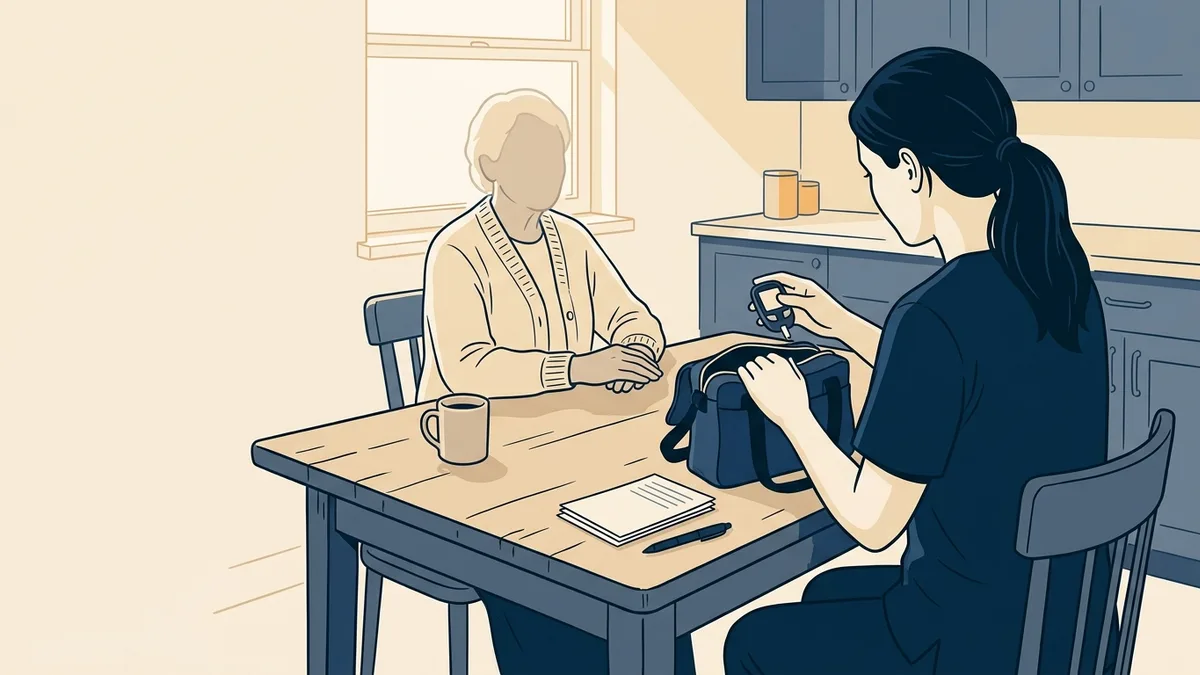
A home health agency or hospice needs a CLIA certificate when its staff perform a test or interpret a result in a patient's home. Staff who only assist a patient's self-test do not trigger CLIA. A parent agency and its branches under one provider number can share one certificate under the temporary testing exception.
Home health agencies and hospices test where their patients live. CMS counted 13,021 home health agency labs and 4,766 hospice labs in September 2026 (CMS laboratory statistics), most of them running a few waived tests such as fingerstick glucose or a waived PT/INR meter. CDC points out why those two matter: waived results "such as prothrombin time and glucose levels, adjust medication dosages for anticoagulant therapy and diabetes."
The CLIA question for an agency is not where the test happens but who does it.
When does a home health agency or hospice need a CLIA certificate?
When its staff perform the test or interpret the result. CMS's FAQ on over-the-counter home testing puts both sides in one answer: "An employee of a facility (i.e., home health agency, hospice, etc.) that provides assistance to an individual while that individual self-administers a home use test is not, by virtue of that assistance, subject to CLIA as long as the test is performed by the individual in accordance with the instructions for use of that particular test. However, if an employee performs the test or interprets the test result for the individual, the facility is subject to CLIA requirements."
CMS's State Operations Manual lists the same carve-out among testing not subject to CLIA: "Laboratory testing conducted in conjunction with the provision of home health or hospice care in an individual's home, where the home health agency or hospice employee merely assists the individual in performing a test, since tests performed by individuals in the home are not subject to CLIA" (Chapter 6, section 6002). And in its multi-site guidance: "If the health care worker only assists the patients and provides the patient's self-testing result to the health care provider, a certificate is not required" (section 6010.1.2.1).
- No certificate: the patient sticks their own finger with their own home-use meter, reads the number, and the nurse writes it down and passes it to the physician.
- Certificate needed: the nurse performs the fingerstick and runs the agency's meter, or reads a result the patient cannot read, and reports it.
Can a parent agency and its branches share one certificate?
Yes, which is unusual. The CMS-116 instructions say under Multiple Sites: "Hospice and HHA could qualify for an exception." Patients' homes are temporary testing locations, which the first exception covers (42 CFR 493.35(b)(1)), and CMS's guidance spells out how agencies use it:
- "A parent HHA with multiple branches may apply for one CLIA certificate as long as these sites are under one HHA provider number, i.e., parent and branch."
- "Subunits that operate independently and have a unique provider number should each apply for a separate CLIA certificate."
- "The parent or provider location must perform laboratory testing," because "the parent defines the services provided in the branches and is responsible for the day-to-day operation, supervision, and administration of laboratory testing, including the employment of qualified personnel."
- For hospices, "The guidance for HHAs applies," with "multiple locations instead of branches" (SOM section 6010.1.2.1).
An agency group with several separately numbered agencies, or a for-profit company with agencies in several states, files one certificate per provider number. See the three multiple-site exceptions.
What does an agency put on the CMS-116?
- Section I: the parent agency's physical address, never a P.O. box, and an email address the agency controls, since CMS has emailed all fee coupons and certificates since March 1, 2026.
- Section III: facility type 12, Home Health Agency, or 13, Hospice.
- Section V: the multiple-site exception, with the branch or location list. For patients' homes, "no individual addresses need to be submitted but should be available upon request" (SOM section 6016.1).
- Section VI: each waived test by analyte, test name and manufacturer, with total annual volume across all branches.
Most agencies need only a Certificate of Waiver. The current CMS fee, as of October 2026, is $248 every two years. The agency's owner or director signs, and the form goes to the State Agency where the parent sits. Our CMS-116 guide covers every field.
What does a waiver agency have to do day to day?
- Follow each manufacturer's instructions (42 CFR 493.15(e)(1)), including any control checks the instructions require. A meter used against its instructions is no longer a waived test.
- Use the instructions for your setting. CMS notes that home-use and provider-facilitated versions of a test generally have separate instructions, and "the appropriate instructions must be followed depending on the setting in which the test is used."
- Keep the branch list current, and send written notice when branches open or close.
- Report changes in ownership, name, location or director within 30 days (493.39(b)).
- Train and document. CDC's free "Ready? Set? Test!" booklet and its online course were written for staff testing under a Certificate of Waiver, and its audience explicitly includes home health agencies. See what belongs in a waiver lab's compliance binder.
Do states license home health testing separately?
Some do. New York lists "home health care agencies" among the sites that need a Limited Service Laboratory registration for waived testing, at $200 per location every two years. See New York's Limited Service Laboratory registration and check others on the state requirements index.
How do we help agencies?
We prepare the parent agency's CMS-116 with the branch list and test menu, and any state registration, for your administrator or director to review and sign; the agency pays CMS on pay.gov. A Certificate of Waiver Application is $399, or $549 with a compliance binder, and branch changes after approval are $149 per change. Agencies with several provider numbers use the five-site package at $1,599.
Common questions
- Does a home health nurse checking blood sugar need CLIA?
- If the nurse performs the test or reads the result for the patient, the agency needs a CLIA certificate, usually a Certificate of Waiver. If the patient tests and reads it themselves, it does not.
- Can our branches use the parent agency's CLIA certificate?
- Yes, if they operate under the same HHA provider number as the parent and the parent performs testing. Subunits with their own provider numbers need separate certificates.
- Do we list every patient's home address on the CMS-116?
- No. CMS says individual home addresses need not be submitted for temporary testing at patient homes, but they must be available on request.
Need Help with Your CLIA Certificate?
We prepare your CMS-116 and any state filing for your owner or director to sign, then track your certificate, changes and renewals.