A company that only ships collection kits and forwards specimens is not a CLIA laboratory, because facilities that only collect specimens or serve as a mailing service are excluded. The lab that tests the returned specimens needs a CLIA certificate covering each test's complexity, plus permits from states such as New York, California and Maryland where specimens originate.
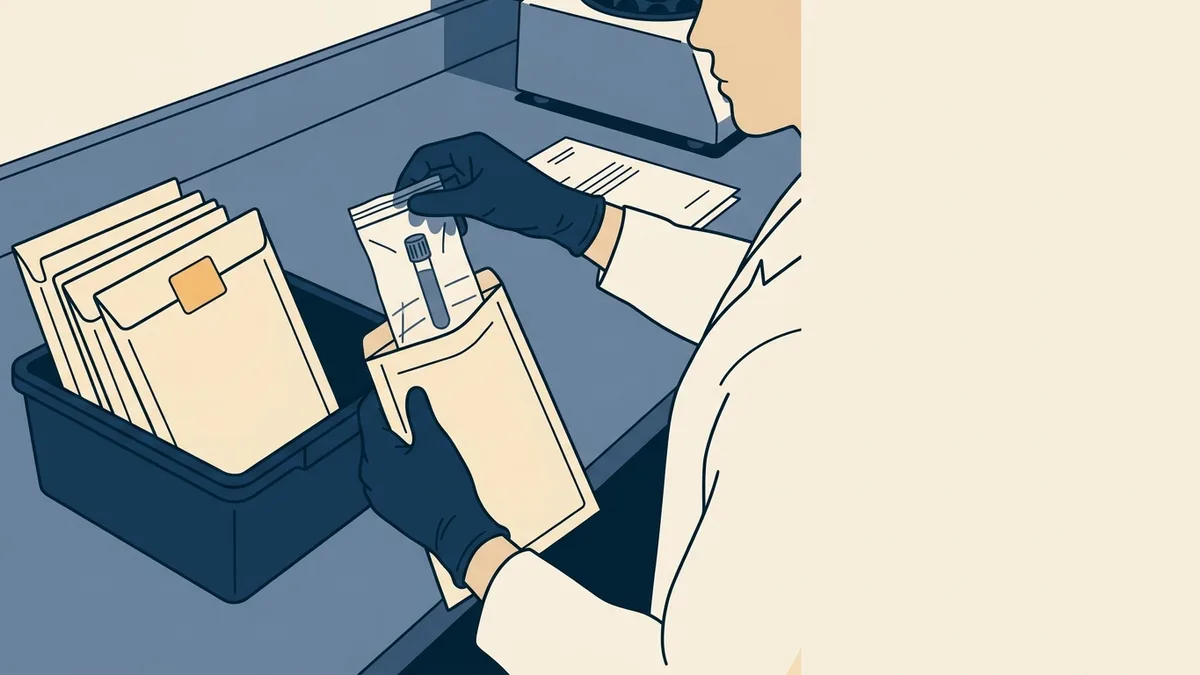
Mail-in testing has three parties: the company that sells or orders the test and ships the kit, the patient who collects the specimen at home, and the laboratory that receives the kit and runs the test. Only one of them is a laboratory under CLIA, and it is the one that performs the examination.
Is a company that ships collection kits a laboratory?
No, as long as it does not test. The federal definition ends with an exclusion written for exactly this: "Facilities only collecting or preparing specimens (or both) or only serving as a mailing service and not performing testing are not considered laboratories" (42 CFR 493.2). The CMS-116 instructions repeat it, and CMS's State Operations Manual lists "Facilities which serve only as collection stations" among those not subject to CLIA, defining a collection station as one that "receives specimens to be forwarded to a laboratory performing diagnostic tests" (Chapter 6, section 6002).
A patient who swabs or pricks their own finger at home is collecting a specimen, not testing it. So a telehealth company that ships kits, a brand that sells them online, and a clinic that hands a patient a kit to mail are all outside CLIA for that step.
The answer changes the moment someone in the company examines the specimen or reads a result from it. A company that receives returned kits and runs even a waived test on them is a lab and needs a certificate at that location. See when a telehealth company needs a CLIA certificate.
What does the processing lab need?
A CLIA certificate that covers the complexity of every test it runs on the returned specimens. Waived tests can run under a Certificate of Waiver; anything moderate or high complexity needs a Certificate of Registration followed by a Certificate of Compliance or Accreditation, with a director qualified under subpart M, enrollment in an approved proficiency testing program for each specialty it is certified in (42 CFR 493.801), and surveys every two years. A test system that FDA has not categorized "is considered high complexity by default" (CMS FAQ on over-the-counter home testing). Validation of a home-collected specimen type is a question for the lab and, for the collection device, the FDA; White Glove Telemedicine's post on telehealth lab partners covers what to ask.
The lab's certificate is tied to its own address. A lab in one state receiving kits from fifty states still holds one CLIA certificate for its location, but it may need permits from the states where specimens originate.
Which states regulate labs that test their residents' specimens?
Several do, and a nationwide mail-in program reaches all of them. From the state texts we have read:
- New York: "Only laboratories that hold a New York State clinical laboratory permit are authorized to perform testing on specimens originating from New York." Occasional testing can go through a Single Use Permit, submitted by the testing lab through eCLEP, a process New York opened on January 9, 2026.
- California: its lab law applies to labs "receiving biological specimens originating in California" (Bus. & Prof. Code 1241(a)).
- Maryland: a license is required to test "specimens acquired from health care providers in this State at a medical laboratory located outside this State," and to "Represent or service in this State a medical laboratory regardless of the laboratory's location" (Health-General 17-205(a)).
- Pennsylvania: a lab outside the state may collect or receive specimens from Pennsylvania patients if it "holds an appropriate Federal license" (28 Pa. Code 5.11(f)).
Rhode Island's lab law reaches "all laboratories and stations performing analytical or clinical laboratory services or specimens in this state" (R.I. Gen. Laws 23-16.2-3), so collection activity there deserves its own check. Our post on testing specimens from other states and the state requirements index carry the details we have verified.
Before launch, what should a kit company confirm?
- The lab's CLIA certificate type and number, and that the certificate covers the specialty of every test on your panel.
- The lab's permits in every state you ship to, starting with New York, California and Maryland.
- That nobody on your side tests. If your team opens returned kits to pre-screen or read anything, that location is a lab.
- Whose CLIA number appears on claims. Medicare's CMS-1500 instructions call for the number of "an entity performing CLIA covered procedures," which is the processing lab. See putting the CLIA number on claims.
Where do we fit in a mail-in program?
For the kit company, usually only in a $149 Readiness Review that confirms the program is collection-only and lists the permits your lab partner should hold. For a company building its own processing lab, our Nonwaived Certificate Application Packet ($1,499) prepares the CMS-116 and the director's qualification documents, and State Lab License or Permit filings are $699 per state. Your director signs, you pay CMS and each state directly, and the quality system and proficiency testing stay with your lab.
Common questions
- Do we need a CLIA certificate to sell at-home collection kits?
- Not for shipping kits and forwarding specimens. The federal definition excludes facilities that only collect or prepare specimens or serve as a mailing service. The testing lab needs the certificate.
- Does the processing lab need a New York permit?
- Yes, to test specimens from New York. New York says only labs holding a New York clinical laboratory permit may test specimens originating there, with a Single Use Permit for occasional testing.
- What if our staff open returned kits and read a result?
- Then that location is performing testing and is a laboratory. It needs a CLIA certificate matching the complexity of the test.
Need Help with Your CLIA Certificate?
We prepare your CMS-116 and any state filing for your owner or director to sign, then track your certificate, changes and renewals.