
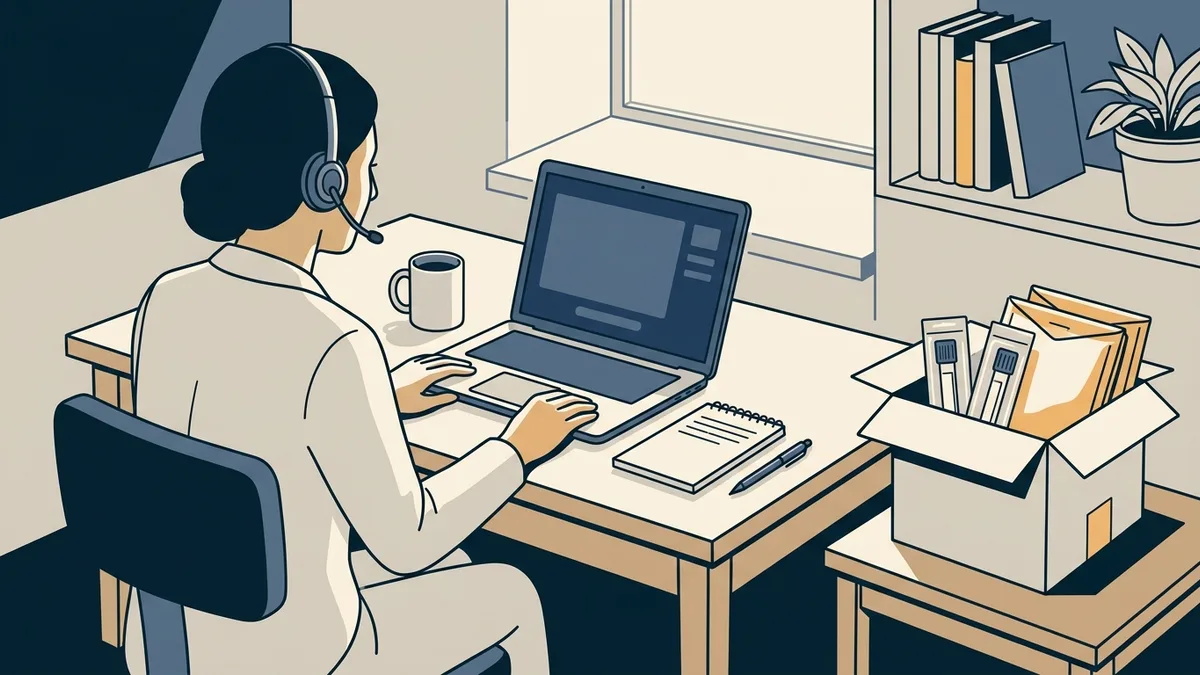
A telehealth company needs a CLIA certificate only where its own staff perform or interpret tests: at clinics or hubs it opens, or in a lab it runs. Ordering tests from a reference lab, shipping collection kits, or sending FDA home-use tests that patients run and read themselves does not make the company a lab.
Telehealth companies ask about CLIA in one of two moments: when they first add lab testing to a care model, and when they open a physical site. The answer turns on a single question. Does anyone working for you examine a human specimen and produce a result used for a patient's care? If not, you are ordering testing, and the lab that performs it holds the certificate. If yes, the place where that happens is a laboratory.
CLIA defines a laboratory by what it does: "a facility for the... examination of materials derived from the human body for the purpose of providing information for the diagnosis, prevention, or treatment of any disease or impairment of, or the assessment of the health of, human beings." The same definition excludes "Facilities only collecting or preparing specimens (or both) or only serving as a mailing service and not performing testing" (42 CFR 493.2).
Which telehealth testing models need a certificate?
1. You order tests; patients visit a reference lab's draw site
No certificate for you. The reference lab performs the testing under its own CLIA certificate, and you are the ordering clinician. Your obligations are about choosing the lab and routing results. White Glove Telemedicine covers that in choosing a lab partner for telehealth.
2. You ship FDA home-use tests that patients run and read themselves
Generally no certificate. CMS says a test "cleared, approved, or authorized specifically for home use by the FDA is not regulated under CLIA when that test is self-administered in accordance with the FDA's authorization and authorized labeling." A patient who performs and reads their own test and then shows the result to someone else as proof is not having it interpreted: CMS says "we do not consider this to be interpretation or reporting" (CMS FAQ on over-the-counter home testing, updated March 4, 2022).
The FAQ draws the boundary just as plainly in the other direction: "If the test is either performed by someone other than the individual being tested... or the results are interpreted or reported by someone other than the individual, then a CLIA certificate would be required." If your workflow has a clinician read the patient's cassette from a photo or video and decide the result, rather than the patient reading it, that falls on the interpretation side of CMS's language. Ask your State Agency before you build it. See home tests, self-testing and CLIA.
3. You mail collection kits that go to a partner lab
No certificate for shipping kits; the lab that tests the returned specimens needs one, and it needs the state permits described below. See mail-in collection kits and the processing lab.
4. You open clinics, kiosks or hubs where staff run tests
Each location needs its own certificate. A waiver lab "must file a separate application for each laboratory location" (42 CFR 493.35(a)), and a for-profit company fits none of the three exceptions. If the hub runs only waived tests, a Certificate of Waiver is enough; the current CMS fee, as of October 2026, is $248 per site every two years. See one certificate per site.
5. You build your own lab to process specimens
That lab needs a certificate matching the most complex test it runs. Anything beyond waived and PPM testing means a Certificate of Registration first, then a Certificate of Compliance after a State Agency survey or a Certificate of Accreditation from a CMS-approved accreditor, with a director qualified under subpart M. See Compliance or Accreditation.
Do states license labs that test their residents' specimens?
This is the part that catches telehealth companies serving patients nationwide, because the lab's home state is not the only one that counts. Examples from the state texts:
- New York: "Only laboratories that hold a New York State clinical laboratory permit are authorized to perform testing on specimens originating from New York." Since January 9, 2026, a lab needing to test a New York specimen occasionally applies for a Single Use Permit, which "must be submitted by the TESTING LABORATORY" through eCLEP (Wadsworth Center, Clinical Laboratory Evaluation Program).
- California: the state's lab law covers "all clinical laboratories in California or receiving biological specimens originating in California" (Bus. & Prof. Code 1241(a)).
- Maryland: a license is required to "Offer or perform medical laboratory tests or examinations on specimens acquired from health care providers in this State at a medical laboratory located outside this State" (Health-General 17-205(a)(2)).
- Pennsylvania: a lab may collect or receive specimens from Pennsylvania patients if it holds a Pennsylvania permit "or holds an appropriate Federal license if the laboratory is located outside of this Commonwealth" (28 Pa. Code 5.11(f)).
Before you sign a lab partner, ask for its CLIA certificate type and number and its permits in each state you serve. Our post on testing specimens from other states goes state by state, and each state requirements page lists out-of-state rules where we found them.
What if the company opens a testing site in another state?
That site needs its own CMS-116, sent to the State Agency where the site sits, and any state registration or license there. Washington replaces the CLIA certificate with its own Medical Test Site license, and New York sends most non-physician sites to its Limited Service Laboratory registration. See Washington and New York.
Who signs for a telehealth company's testing site?
The application "must... Be signed by an owner, or by an authorized representative of the laboratory who attests that the laboratory will be operated in accordance with requirements established by the Secretary" (42 CFR 493.35(c)(2)), and the CMS-116 signature line reads "SIGNATURE OF OWNER/DIRECTOR OF LABORATORY." Above it, the applicant consents "to permit the Secretary... to inspect the laboratory and its operations and its pertinent records at any reasonable time." The form also warns that anyone who "intentionally violates any requirement of section 353 of the Public Health Service Act" faces up to one year in prison, or three for a repeat violation. For a company with many sites, decide early who in the organization signs for each location, and keep the director named on each form aware that their name is on it. Misrepresentation in obtaining a CLIA certificate is itself a ground for CMS to suspend, limit or revoke it (42 CFR 493.1840(a)(1)).
Whose CLIA number goes on the claim?
The lab that performed the test. Medicare's CMS-1500 instructions say to enter "the 10-digit Clinical Laboratory Improvement Act (CLIA) certification number for laboratory services billed by an entity performing CLIA covered procedures" (Claims Processing Manual, Chapter 26, item 23). A telehealth practice billing only its own visit has no lab test to report; a company that bills for tests run at its own site reports that site's number. See putting the CLIA number on claims.
How do we help telehealth companies?
We start with a $149 Readiness Review of your care model: which steps are collection, which are testing, which states your specimens come from, and which certificates and permits follow. If you open sites, a Certificate of Waiver Application is $399 per site, the five-site package is $1,599, and rollouts of 10 or more are $249 per site. If you are building your own nonwaived lab, our Nonwaived Certificate Application Packet ($1,499) prepares the CMS-116 with its nonwaived test table and the director's qualification documents; your director, quality system and proficiency testing remain yours. Every application is reviewed and signed by your owner or director, and you pay CMS and the states directly.
Common questions
- Does a telehealth company that orders lab tests need a CLIA certificate?
- No. The lab that performs the test holds the certificate. A company that only orders tests, collects specimens or acts as a mailing service is not a laboratory under 42 CFR 493.2.
- Can our clinicians read a patient's home test over video without CLIA?
- CMS says a certificate is required when results are interpreted or reported by someone other than the person tested. A patient showing their own result as proof is not interpretation. Ask your State Agency before building a workflow where the clinician decides the result.
- Does our partner lab need a New York permit for New York patients?
- Yes. New York says only labs holding a New York clinical laboratory permit may test specimens originating there. Occasional testing can go through a Single Use Permit, which the testing lab applies for.
- Do telehealth testing hubs in different cities share one certificate?
- No. Each fixed location that tests needs its own CMS-116 and certificate, because a for-profit company fits none of the multiple-site exceptions.
Need Help with Your CLIA Certificate?
We prepare your CMS-116 and any state filing for your owner or director to sign, then track your certificate, changes and renewals.