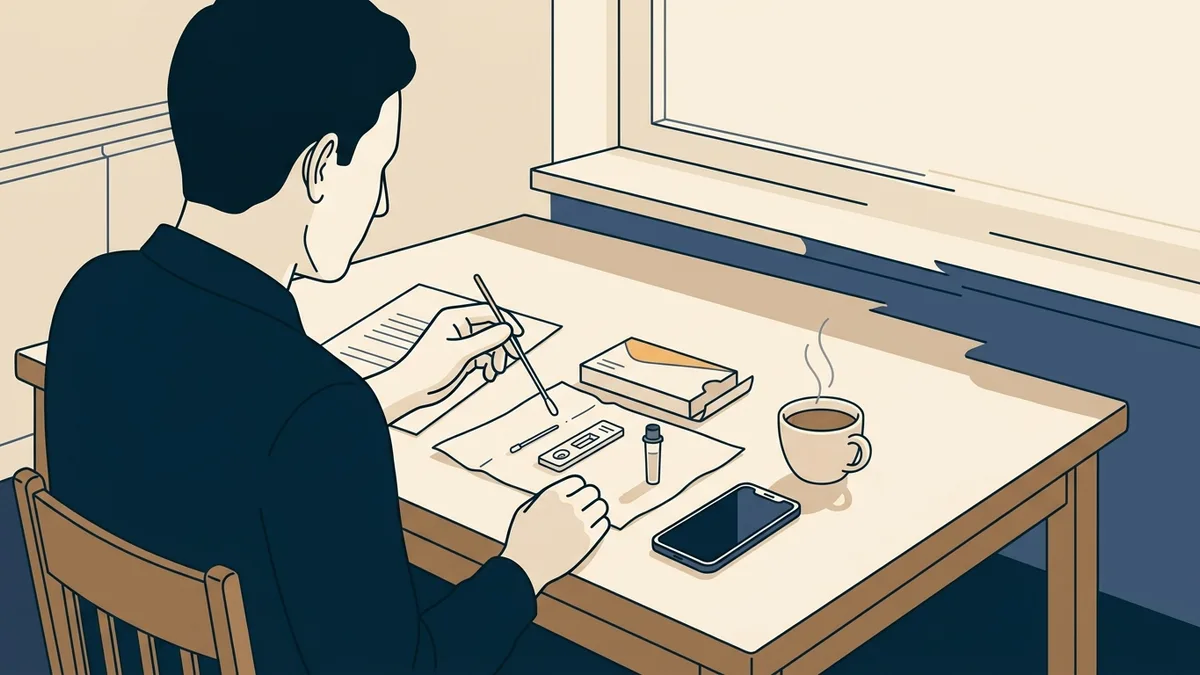
A home-use test the person runs and reads on themselves, as its FDA labeling allows, is not regulated under CLIA. Once a staff member performs the test or interprets or reports the result, the facility needs a CLIA certificate, usually a Certificate of Waiver. Showing your own result as proof, or a parent testing a child, still counts as self-testing.
Home tests changed the CLIA question for a lot of organizations. A school, an employer or a telehealth company can buy the same rapid test a family buys at a pharmacy. Whether using it requires a CLIA certificate depends not on the test but on who performs it and who reads the result.
CMS answered this in a set of frequently asked questions on over-the-counter home testing, issued November 22, 2021 and updated March 4, 2022. The FAQ was written during the COVID-19 response, but its rule is general: it is about tests "cleared, approved, or authorized specifically for home use by the FDA," of any kind.
When is a home test outside CLIA?
When the person being tested runs it on themselves and follows its labeling. In CMS's words: "Generally, a test that has been cleared, approved, or authorized specifically for home use by the FDA is not regulated under CLIA when that test is self-administered in accordance with the FDA's authorization and authorized labeling."
Three extensions of that rule are in the FAQ itself:
- A helper for someone who cannot test themselves. Testing "performed by an individual, including a parent or guardian, for a child or an adult who is unable to test themselves... to the extent authorized in the manufacturer's Instructions for Use (IFU), is considered self-testing for purposes of CLIA and would not require a CLIA certificate."
- Showing the result as proof. If someone tests themselves at work and "shows their test result to someone else (e.g., employer) as proof of their result, we do not consider this to be interpretation or reporting... In this case, CLIA certification is not required."
- Staff who assist. "An employee of a facility (i.e., home health agency, hospice, etc.) that provides assistance to an individual while that individual self-administers a home use test is not, by virtue of that assistance, subject to CLIA as long as the test is performed by the individual in accordance with the instructions for use."
When does a home test need a CLIA certificate?
As soon as someone other than the person tested performs it or reads it. "If the test is either performed by someone other than the individual being tested (e.g., other staff, employee health personnel), or the results are interpreted or reported by someone other than the individual, then a CLIA certificate would be required."
CMS applied that to group settings directly: "a facility where a staff member is performing testing and/or interpreting / reporting test results needs a CLIA certificate to perform testing, even if the test is authorized by the FDA for home use. This includes testing using OTC home tests performed by someone other than the individual in a facility such as a school, shelter, jail, or other location." The reason it gives is the statute: "CLIA prohibits any person from soliciting or accepting human specimens without a valid CLIA certificate if the test results are used to diagnose, prevent, treat, or assess health."
| Scenario | CLIA certificate? |
|---|---|
| Employee swabs themselves at work and shows the result to a supervisor | No |
| Parent tests a young child at home as the instructions allow | No |
| Home health aide steadies the kit while the patient tests and reads it | No |
| School nurse swabs a student and reads the cassette | Yes |
| Employee health staff run the test for workers | Yes |
| Home health nurse performs the test or reads the result for the patient | Yes, for the agency |
For most of these sites the right certificate is a Certificate of Waiver, because FDA clearance for home use is one of the criteria for a waived test (42 CFR 493.15(b)(1)). The current CMS fee, as of October 2026, is $248 every two years. See CLIA for schools, shelters and employer clinics and CLIA for home health agencies and hospices.
Can a clinic use a home test on its patients?
Yes, with a certificate and the right instructions. CMS says home tests "may also be used in CLIA-certified facilities that perform waived, moderate and high complexity testing; provided the tests have been authorized for use in those settings by the FDA." It also notes that "Generally, there are separate Instructions for Use designated for OTC home use (i.e., self-testing) and for healthcare provider-facilitated testing," and "the appropriate instructions must be followed depending on the setting in which the test is used."
The trap is improvising. "If the test kit is used 'off-label' (i.e., not used as per the IFU, or if the IFU are modified), the test complexity defaults to high complexity," which a waiver lab is not certified to perform. See off-label use of waived tests.
What about tests that are not authorized for home use?
They stay inside CLIA. Asked whether a COVID-19 test without home-use authorization could be used for self-testing at a facility without a certificate, CMS answered "No," adding that "Any test not authorized for home use is only authorized for use in settings operating under a CLIA certificate." The same logic applies to any professional-use kit: buying it does not let a non-certified site run it, and handing it to the patient does not make it a self-test.
The FAQ also covers tests sold under emergency use authorization, which are not categorized and do not appear in FDA's CLIA database: "Tests authorized under EUA for use at the point of care (POC) are deemed to be CLIA waived tests while the EUA is in effect," and the authorized settings are listed in each test's Letter of Authorization.
Do states follow the same line?
CMS's FAQ itself warns that "Some states have laboratory requirements that are more stringent than CLIA." California's lab law, for example, excludes "individuals who perform clinical laboratory tests or examinations, approved by the federal Food and Drug Administration for sale to the public without a prescription in the form of an over-the-counter test kit, on their own bodies or on their minor children or legal wards" (Bus. & Prof. Code 1241(b)(7)), which mirrors the federal self-testing rule but is framed around over-the-counter kits. Check your state on the state requirements index before relying on the federal line alone.
How do we help with home-test programs?
We map your workflow against CMS's FAQ in a $149 Readiness Review: who touches the swab, who reads the result, and who records it. Where the answer is a certificate, a Certificate of Waiver Application is $399 per site, and multi-site programs start at $1,599 for five sites. Your owner or director signs each application, and you pay CMS directly on pay.gov.
Common questions
- Does a school need CLIA to run home COVID tests on students?
- Yes, if staff perform the test or read the result. CMS says a facility such as a school, shelter or jail needs a CLIA certificate in that case, even with a test authorized for home use.
- Is helping someone with a home test regulated by CLIA?
- Not by itself. CMS says a home health or hospice employee who only assists while the person self-administers the test is not subject to CLIA. Performing or interpreting it is.
- Can my clinic use home test kits on patients?
- Yes, under a CLIA certificate and only in a setting the FDA authorized, following the right instructions. Using a kit off-label makes it high complexity.
- Do employees showing their own test result to HR trigger CLIA?
- No. CMS says showing your own result as proof is not interpretation or reporting, so no certificate is needed.
Need Help with Your CLIA Certificate?
We prepare your CMS-116 and any state filing for your owner or director to sign, then track your certificate, changes and renewals.