
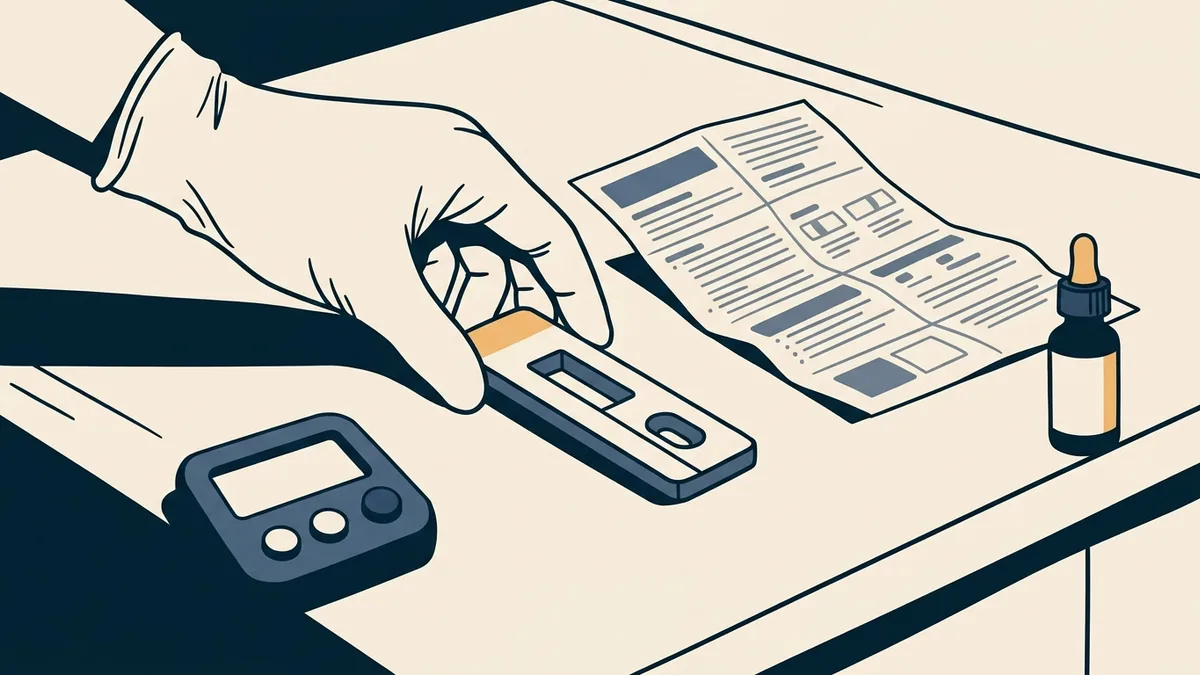
A waived test stays waived only when run exactly as its instructions for use say. If a kit is used off-label, with a different specimen, device, timing or steps, or with modified instructions, CMS says its complexity defaults to high complexity. A Certificate of Waiver does not cover high complexity testing, so the lab is testing outside its certificate.
"Waived" describes a specific test system used a specific way. FDA categorizes the system based on its instructions for use, and a Certificate of Waiver lab is allowed to run it only within those instructions. Step outside them and the test is no longer the test FDA categorized.
CMS says so directly. If a test kit is used "'off-label' (i.e., not used as per the IFU, or if the IFU are modified), the test complexity defaults to high complexity and facilities must be able to meet CLIA requirements for high complexity testing" (CMS FAQ on over-the-counter home testing, updated March 4, 2022). The regulation behind it is short: a waiver lab must "Follow manufacturers' instructions for performing the test" (42 CFR 493.15(e)(1)).
What counts as off-label use of a waived test?
Anything the instructions do not allow, or anything that changes them. In practice that usually means one of these:
- A different specimen. Running a urine kit on another fluid, a nasal swab kit on a throat swab, or a fingerstick device on a specimen type it was not cleared for.
- A different collection device. CDC's self-assessment checklist for waived sites asks: "Do you use the recommended collection device when collecting samples, including using only swabs that come in the sample collection or the test kit?"
- Processed specimens. The same checklist asks, "Do you only use unprocessed samples for performing waived tests?" Spinning, diluting or pooling a specimen the instructions do not mention is a modification.
- Changed timing or steps. Reading a cassette early or late, skipping a step, or reordering steps. CDC recommends you "follow the manufacturer's instructions in the exact order" and "use timers."
- A different population or purpose. Using a test on patients or for a purpose its labeling excludes.
- The wrong set of instructions. CMS notes that home-use and provider-facilitated versions of a test generally carry separate instructions, and "the appropriate instructions must be followed depending on the setting in which the test is used."
Some lab practices sit close to the line without crossing it, such as storing reagents correctly, letting refrigerated kits reach room temperature, and never mixing components from different lots. The CDC checklist lists each of those as good practice, and where the instructions require them, skipping them means the test is not being run as instructed.
Why does high complexity matter to a waiver lab?
That the lab is suddenly doing testing its certificate does not allow. A Certificate of Waiver "can only perform tests categorized as waived" (Form CMS-116 instructions). High complexity testing requires a Certificate of Registration and then a Certificate of Compliance or Accreditation, a director meeting the high complexity qualifications in subpart M, proficiency testing enrollment for each specialty (42 CFR 493.801) and surveys every two years. A waiver lab has none of that in place.
The regulatory consequences follow from there:
- Testing outside the certificate. CMS may suspend, limit or revoke a certificate when a lab "Performed... a laboratory examination or other procedure that is not within a category of laboratory examinations or other procedures authorized by its CLIA certificate" (42 CFR 493.1840(a)(2)).
- Inspection exposure. Waiver labs are not routinely surveyed, but CMS may inspect one "to determine whether the laboratory is performing tests beyond the scope of the certificate held by the laboratory" (493.1775(b)(3)).
- Alternative sanctions. Since CMS's 2023 fee rule, civil money penalties and other alternative sanctions can be imposed on waiver labs, not only revocation. See CLIA sanctions.
Is an uncategorized test treated the same way?
Yes. A test system that FDA has not categorized at all "is considered to be a test of high complexity" until it is (42 CFR 493.17(c)(4)), and CMS repeats that "Any test that has not been categorized is considered high complexity by default." A kit bought from an unfamiliar supplier, or a research-use-only product, is not waived just because it looks like a rapid test. Check the exact system in FDA's CLIA database first. See how to tell whether a test is CLIA-waived.
How do you keep testing on-label?
- Keep the current instructions at the bench. CDC asks whether you "check the manufacturer's instructions with each new lot and shipment of test kits," file the old copy and tell testing staff when something changes.
- Write your procedure from the instructions, not from memory. A one-page bench guide per test, built from the instructions and dated, is easy to check against the kit.
- Train before testing and record it. CDC's checklist asks whether all staff completed training "before performing temperature checks, blood collection, sample testing, and reporting patient results."
- Route new uses through a check. When a clinician asks to try a kit on a new specimen or patient group, treat it as a change to your menu, not an improvisation. See adding tests to your menu.
A compliance binder organized around those steps is the simplest way to show an inspector that your waived tests are being run as waived tests.
Can we help keep your tests on-label?
Our Waiver Application with Compliance Binder ($549 per site) builds the test menu from each kit's instructions and a binder organized around CDC's waived testing guidance. For a lab already certified, a $149 Readiness Review checks your kits and procedures against FDA categorization and your certificate. If a test you need really is moderate or high complexity, our Nonwaived Certificate Application Packet ($1,499) prepares the CMS-116 for the right certificate; the director and quality system remain the lab's own.
Common questions
- What happens if we use a waived test on a specimen it was not cleared for?
- CMS says off-label use makes the test default to high complexity. A Certificate of Waiver lab is then performing testing its certificate does not allow, which is a ground for sanctions.
- Is using a different swab than the one in the kit off-label?
- If the instructions call for the kit's swab, yes. CDC's checklist for waived sites asks whether you use only the swabs that come with the collection or test kit.
- Is a rapid test not in the FDA database waived?
- No. A test system that has not been categorized is treated as high complexity under 42 CFR 493.17(c)(4).
Need Help with Your CLIA Certificate?
We prepare your CMS-116 and any state filing for your owner or director to sign, then track your certificate, changes and renewals.