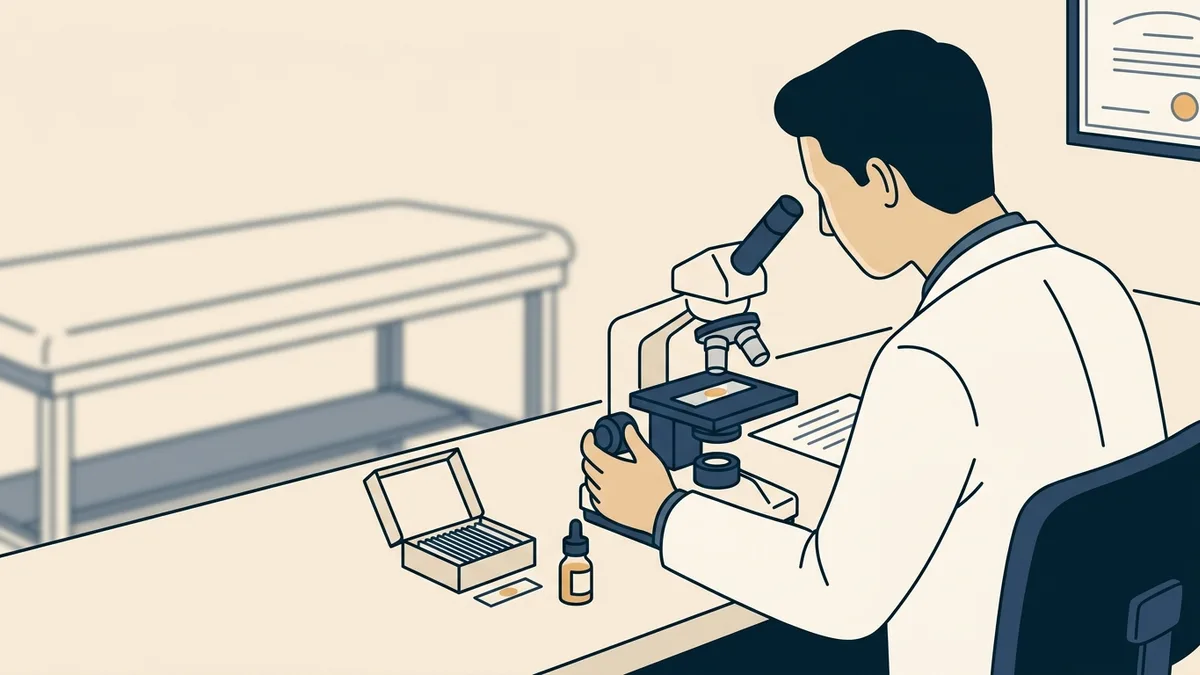
A PPM certificate covers nine microscopy procedures, including wet mounts, KOH preps and urine sediment, plus waived tests. The treating practitioner must personally perform them during the visit with a brightfield or phase-contrast microscope. The director must qualify under 42 CFR 493.1357, and the CMS fee is $297 as of October 2026.
The Certificate for Provider-Performed Microscopy Procedures, usually shortened to PPM or PPMP, sits between a Certificate of Waiver and a full nonwaived lab. It exists for a specific kind of testing: a clinician looks at a fresh specimen under the microscope during the visit, and the answer shapes treatment before the patient leaves. CMS's September 2026 statistics count 21,736 PPM labs, 16,123 of them physician offices.
Which nine procedures does the certificate cover?
42 CFR 493.19(c) limits PPM examinations to these, plus waived tests "and no others":
- Direct wet mount preparations for the presence or absence of bacteria, fungi, parasites and human cellular elements
- Potassium hydroxide (KOH) preparations
- Pinworm examinations
- Fern tests
- Post-coital direct, qualitative examinations of vaginal or cervical mucus
- Urine sediment examinations
- Nasal smears for granulocytes
- Fecal leukocyte examinations
- Qualitative semen analysis, limited to the presence or absence of sperm and detection of motility
The CMS-116 repeats the list in Section VII and calls these "the only PPM tests that can be performed by a facility having a Certificate for PPM." A Gram stain, a manual cell count or a quantitative semen analysis is not on it, and needs a Certificate of Compliance or Accreditation.
Who is allowed to perform a PPM procedure?
Only the practitioner seeing the patient. Under 493.19(b), the examination "must be personally performed" by:
- a physician, during the patient's visit, on a specimen from their own patient or a patient of their group practice;
- a midlevel practitioner, under a physician's supervision or in independent practice if the state allows it, on the same terms; or
- another practitioner the rule names, on the same terms.
The regulation defines a midlevel practitioner as a nurse midwife, nurse practitioner, nurse anesthetist, clinical nurse specialist or physician assistant licensed by the state (493.2). The procedure must use a brightfield or phase-contrast microscope (493.19(b)(3), 493.1365(b)), and 493.1353 adds that PPM procedures count as such "only when personally performed by a health care provider during a patient visit in the context of a physical examination." A medical assistant, nurse or lab technician reading the slide does not fit, however skilled.
What are the director requirements?
Unlike a waiver lab, a PPM lab's director must qualify under 42 CFR 493.1357. The director must hold any state lab director license the state requires, and must be a physician, a midlevel practitioner "authorized by a State to practice independently in the State in which the laboratory is located," or one of the other practitioners the rule names. The director must also be eligible to be a lab operator under the enforcement rules.
Under 493.1359, the director may "direct no more than five laboratories" and must evaluate the competency of everyone performing PPM procedures. The evaluation includes direct observation, monitoring how results are recorded and reported, reviewing results, assessing performance on blind or external samples, and assessing problem solving. It is documented "at least semiannually during the first year the individual tests patient specimens" and at least annually after that. See laboratory director requirements by certificate type and the five-lab limit.
How does applying for a PPM certificate differ from a waiver?
The same Form CMS-116 applies, with three differences:
- Complete Sections I through VII and IX through X. Section VII is the checklist of PPM procedures and their annual volume; Section VI lists any waived tests.
- Send proof of the director's qualifications with the form. The CMS-116 instructions list "Verification of State Licensure, as applicable," education documents such as a diploma or transcript, credentials and laboratory experience, and warn that "failure to submit this information will delay the processing of your application."
- Pay the PPM fee. As of October 2026, the current CMS fee for a PPM certificate is $297 for two years, from the emailed coupon on pay.gov.
Our CMS-116 walkthrough covers each field.
What rules apply after the certificate is issued?
A PPM lab is subject to the applicable requirements of subparts H, J, K and M of Part 493, the nonwaived rules on proficiency testing, facility administration, quality systems and personnel, to the extent they reach PPM procedures (493.47(c)). In practice that means written procedures, competency records and the quality checks subpart K requires. One example: subpart K requires a lab to verify, at least twice a year, the accuracy of any test it performs that is not in the proficiency testing list in subpart I (493.1236(c)(1)).
On inspections, PPM labs are treated like waiver labs. They are "not subject to biennial inspections" but may be inspected at any time during operating hours to check a complaint, a risk to public health, or testing beyond the certificate (493.1775). Notification rules are stricter on the testing side: a PPM lab must tell the State Agency before performing any moderate or high complexity test that is not a PPM procedure, and within 30 days of a change in ownership, name, location or director (493.53).
Is PPM the right certificate, or is something else?
- Only waived tests, no microscopy? A Certificate of Waiver is simpler and cheaper.
- Microscopy read by staff who are not the treating practitioner? That is not PPM. It is moderate complexity testing under a Certificate of Compliance or Accreditation. See moving to moderate complexity testing.
- Several clinicians across several offices? Each fixed location generally needs its own certificate (493.43(a)), and a director can direct no more than five PPM, Compliance or Accreditation labs.
The five CLIA certificate types compares all of them.
How can White Glove CLIA help with a PPM application?
A PPM Certificate Application is $599 per site. We prepare the CMS-116 with Sections VI and VII, assemble the director's license verification and qualification documents, and hand the packet to the owner or director to review and sign; we can then send it to the State Agency. The lab pays the CMS coupon on pay.gov. We do not act as a laboratory director or perform competency evaluations; those stay with the director the rule requires. If your state also licenses or registers PPM labs, check the state requirements index.
Common questions
- Can a medical assistant read a wet mount under a PPM certificate?
- No. Under 42 CFR 493.19(b), PPM procedures must be personally performed by the qualifying practitioner during the patient's visit, such as the physician or a midlevel practitioner seeing that patient. Microscopy by other staff is moderate complexity testing that needs a different certificate.
- Is a Gram stain a PPM procedure?
- No. The nine PPM procedures are listed in 42 CFR 493.19(c), and a Gram stain is not among them. It requires a Certificate of Compliance or Certificate of Accreditation.
- How much is the CMS fee for a PPM certificate?
- As of October 2026, $297 for the two-year certificate, according to the fee schedule CMS links from its application page. The lab pays it on pay.gov from the emailed fee coupon.
- Does a PPM lab get routine CLIA surveys?
- No. PPM labs are not subject to biennial inspections under 42 CFR 493.1775, but CMS or the State Agency can inspect on a complaint, a public health risk, or to check for testing beyond the certificate.
Need Help with Your CLIA Certificate?
We prepare your CMS-116 and any state filing for your owner or director to sign, then track your certificate, changes and renewals.