A pharmacy needs a CLIA certificate at each store where staff perform a test or read the result for a customer. Most hold a Certificate of Waiver. A customer self-testing with an FDA home-use kit is outside CLIA. State law decides who may order and perform tests and whether a state lab license applies.
Pharmacies are one of the largest groups of CLIA laboratories in the country. CMS counted 22,728 pharmacy labs in September 2026, about 7.5 percent of all 301,284 registered labs (CMS laboratory statistics). Most of them run a short menu of waived tests: flu and strep antigen tests, COVID-19 tests, A1c, lipid panels, glucose.
The federal rule is the same for a pharmacy as for a physician's office. A facility that examines human specimens "for the purpose of providing information for the diagnosis, prevention, or treatment of any disease or impairment of, or the assessment of the health of, human beings" is a laboratory (42 CFR 493.2), and "WAIVED TESTS ARE NOT EXEMPT FROM CLIA" (Form CMS-116 instructions). What differs for pharmacies is the layer of state law on top: who may order the test, who may perform it, and whether the state wants its own lab license.
When does a pharmacy need a CLIA certificate?
When pharmacy staff perform a test or read the result for a customer. The line comes from CMS's FAQ on over-the-counter home tests (November 2021, updated March 2022):
- A test "cleared, approved, or authorized specifically for home use by the FDA is not regulated under CLIA when that test is self-administered in accordance with the FDA's authorization and authorized labeling."
- "If the test is either performed by someone other than the individual being tested... or the results are interpreted or reported by someone other than the individual, then a CLIA certificate would be required."
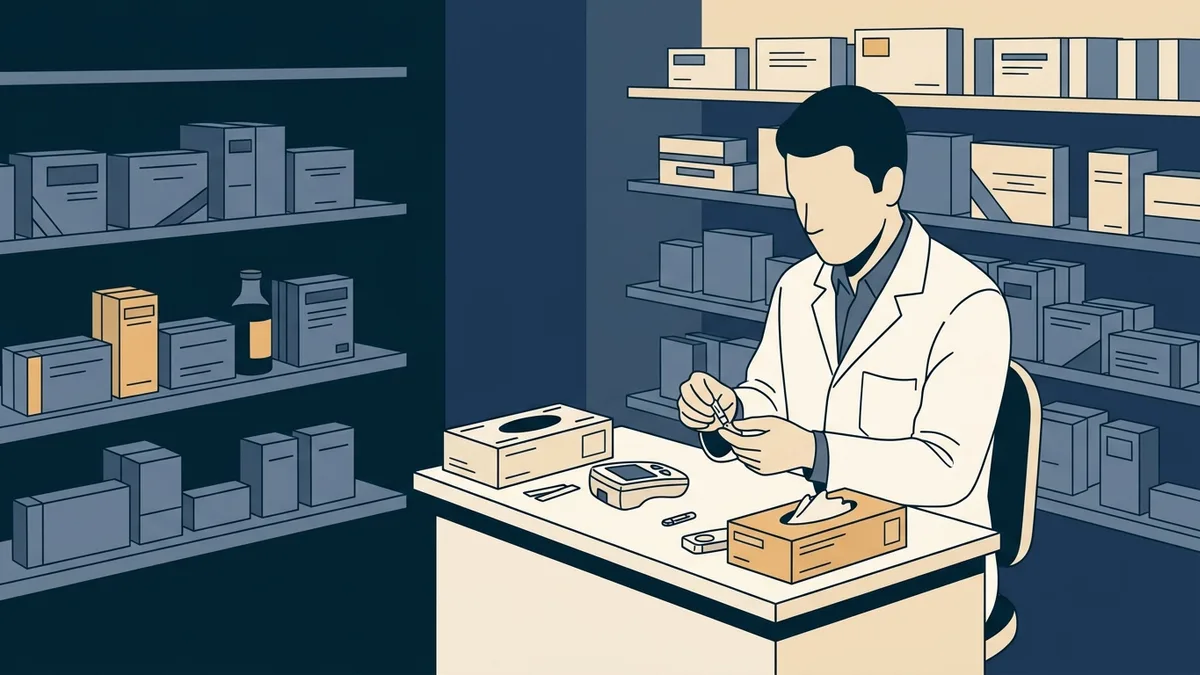
Selling a home COVID test off the shelf is retail. Swabbing the customer behind the counter, or reading the cassette and telling them the result, is laboratory testing. A pharmacy offering any point-of-care test service needs a certificate at that store before it starts.
Which certificate does a pharmacy usually need?
A Certificate of Waiver, if every test it runs is categorized as waived. The FDA's CLIA database is the authority on each specific test system, and a kit used differently from its instructions loses its waived status: CMS says that if a kit is used "off-label (i.e., not used as per the IFU, or if the IFU are modified), the test complexity defaults to high complexity." See off-label use of waived tests.
On the CMS-116, a pharmacy checks facility type 20, Pharmacy, in Section III. Section VI lists every waived test by analyte, test name and manufacturer, with an estimated annual volume. The current CMS fee for a Certificate of Waiver, as of October 2026, is $248 every two years, paid by the pharmacy on pay.gov after CMS emails the fee coupon.
Does every store in a chain need its own certificate?
Yes. A waiver lab "must file a separate application for each laboratory location" unless one of three exceptions applies (42 CFR 493.35). The exceptions cover mobile and temporary testing, limited public health testing by not-for-profit or government labs, and hospital campuses. A retail pharmacy chain is none of these, so each store that tests files its own CMS-116 and pays its own fee. Read one certificate per site, and the three exceptions for the detail, including when screening at an off-site health fair can fall under a store's certificate as a temporary testing location.
Who can be the laboratory director at a pharmacy?
For a Certificate of Waiver, federal rules set no qualifications for the director, and the CMS-116 asks only for the director's name, phone number and credentials. States are another matter:
- New York pharmacies outside the physician office route need a Limited Service Laboratory registration. The program accepts a PharmD or RPh as the director designee, but "A PharmD or RPh designee may only order COVID-19 and/or Influenza testing. A separate alternate ordering source from another licensed health care practitioner is required for any additional tests" (Wadsworth Center, Limited Service Laboratories). The registration is $200 per location every two years. See New York.
- Maryland counts a pharmacy lab as a point-of-care laboratory (COMAR 10.10.01.03). A licensed pharmacist with training in the tests may direct it under a letter of exception instead of a permit, and a lab under a letter of exception "may perform one or more CLIA waived tests" (COMAR 10.10.03.02). See Maryland.
A pharmacy that wants to read wet mounts or other microscopy would need a PPM certificate, and pharmacists are not among the practitioners who may perform PPM procedures under 42 CFR 493.19. In practice, pharmacies stay with waived testing.
How do state lab laws treat pharmacies?
Here is what we have read in state law for the states pharmacies ask about most. Each state page on our state requirements index carries its sources.
- California. Every lab doing waived tests must register with the state (Bus. & Prof. Code 1265(a)(2)), and a pharmacist may perform an FDA-approved or authorized waived test for listed conditions, including strep throat, respiratory illness, urinary tract infection and diabetes, only in "a pharmacy laboratory that is appropriately licensed in California as a laboratory pursuant to Section 1265" (Bus. & Prof. Code 4052.4). See California.
- Georgia. House Bill 93 (2021) repealed Georgia's separate clinical lab licensure and rewrote "pharmacy care" to include "Ordering and administering tests that have been cleared or approved for home use" by FDA, at a pharmacy "operating under a certificate of waiver" or other needed CLIA certification. See Georgia.
- Kentucky. The state lab licensing law does not apply to a pharmacy holding a Kentucky pharmacy permit and a CLIA certificate when it tests "solely and exclusively in connection with assisting a patient with the use of CLIA-waived tests available from the facility's stock or inventory," or under collaborative care agreements. If the pharmacy receives or performs any referred work, the full law applies (KRS 333.040(5)). See Kentucky.
- Maine. The Maine Medical Laboratory Act exempts physicians, physician associates, family nurse practitioners, rural health clinics and group practices testing their own patients (22 M.R.S. 2013-A). Pharmacies are not on that list. See Maine.
- Rhode Island. The state lab law exempts "Licensed pharmacists performing limited function tests" and anyone performing only limited-function tests as the health director defines them (R.I. Gen. Laws 23-16.2-3). See Rhode Island.
Whether a pharmacist may prescribe on a positive result is a separate question, answered by state pharmacy practice law rather than CLIA. Our post on pharmacy test-and-treat covers that split.
What does a pharmacy have to do after the certificate arrives?
The federal duties for a waiver lab are short, and they are enforced:
- Follow the manufacturer's instructions for every test (42 CFR 493.15(e)(1)).
- Run only waived tests. Notify the State Agency before performing any test outside the certificate (493.39(a)). Performing a test "not within a category of laboratory examinations or other procedures authorized by its CLIA certificate" is a ground for revocation (493.1840(a)(2)).
- Report changes within 30 days: ownership, name, location or director (493.39(b)). A pharmacy that changes pharmacist-in-charge often changes its named director too.
- Allow inspection. Waiver labs are not routinely surveyed, but CMS may inspect "at any time during the laboratory's hours of operation" to investigate a complaint or check whether the lab is testing beyond its certificate (493.1775(b)).
- Pay the renewal coupon. CMS sends waiver labs a renewal invoice six months before the certificate expires, by email since March 1, 2026.
CDC's free "Ready? Set? Test!" booklet and self-assessment checklist were written for "physicians, nurses, medical assistants, pharmacists, and others" testing under a Certificate of Waiver. They are recommendations, not rules, and they make a good backbone for store procedures. See what belongs in a waiver lab's compliance binder.
How can we help a pharmacy get certified?
We prepare the CMS-116 for each store, build the test menu from each kit's instructions, and prepare any state registration or license. The pharmacy's owner or named director reviews and signs, and the pharmacy pays CMS and the state directly. Our Certificate of Waiver Application is $399 per store, or $549 with a compliance binder; chains use the five-store package at $1,599 or $249 per store at 10 or more. State lab registrations are $299 per state and full state licenses or permits are $699 per state.
Common questions
- Does selling home COVID tests require a CLIA certificate?
- No. CMS says a home-use test self-administered under its FDA labeling is not regulated under CLIA. A certificate is needed when pharmacy staff perform the test or interpret or report the result.
- Can a pharmacist be the director of a CLIA waiver lab?
- Federal rules set no qualifications for a Certificate of Waiver director. Some states set their own; New York, for example, accepts a pharmacist as director designee but limits what that pharmacist may order.
- Does each pharmacy location need its own CLIA certificate?
- Yes. A retail pharmacy chain fits none of the three multiple-site exceptions, so each store that tests files its own CMS-116 and pays its own certificate fee.
- Can a pharmacy with a waiver run a wet mount or other microscopy?
- No. Microscopy procedures need at least a PPM certificate, and only physicians, midlevel practitioners and the other practitioners named in 42 CFR 493.19 may perform them.
Need Help with Your CLIA Certificate?
We prepare your CMS-116 and any state filing for your owner or director to sign, then track your certificate, changes and renewals.