
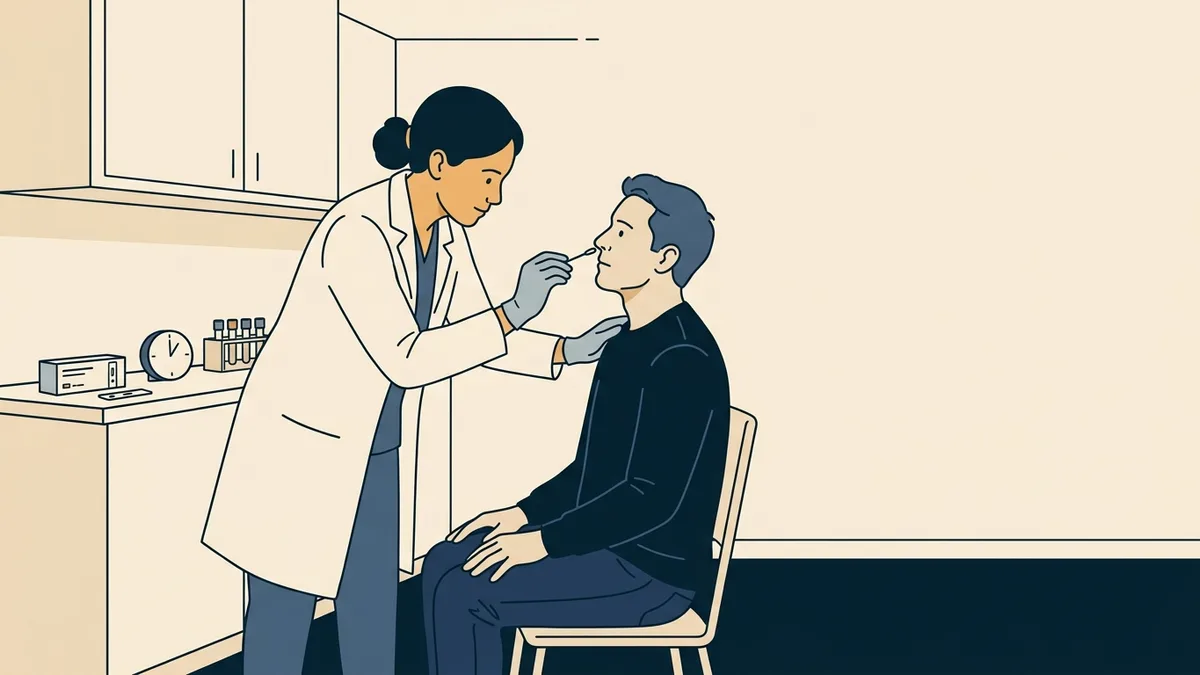
In pharmacy test-and-treat, CLIA governs only the test: each store needs a CLIA certificate, usually a Certificate of Waiver, and must run each waived kit exactly by its instructions. State pharmacy law decides who may order the test and who may prescribe on the result. A CLIA certificate never grants prescribing authority.
A pharmacy test-and-treat service usually looks like this: a customer with flu or strep symptoms comes to the counter, the pharmacist swabs them, a rapid test runs for a few minutes, and a positive result leads to a prescription the same visit. Two separate bodies of law govern those steps, and pharmacies get into trouble when they treat one as if it settled the other.
CLIA, the federal lab law, governs the test. It asks whether the store holds the right certificate and whether the test is run the way FDA categorized it. State pharmacy law governs everything around the test: whether a pharmacist may order it, whether the pharmacist may prescribe on the result, and under what protocol. A CLIA certificate never grants prescribing authority, and a prescribing protocol never replaces the CLIA certificate.
Which CLIA rules govern the testing half?
Three things, at every store that offers the service:
- A certificate at that location. Swabbing a customer and reading the result is laboratory testing. CMS's home testing FAQ says a certificate is required whenever a test "is either performed by someone other than the individual being tested... or the results are interpreted or reported by someone other than the individual." Each store files its own CMS-116 (42 CFR 493.35(a)). See CLIA certificates for pharmacies.
- Waived tests only, under a Certificate of Waiver. The certificate lets the store "only perform tests categorized as waived" (Form CMS-116 instructions). Confirm each specific kit in FDA's CLIA database. Common test-and-treat kits carry Medicare's QW waived codes, such as 87880QW for strep A antigen and 87804QW for influenza antigen, and since January 1, 2026, 87812QW for a combined COVID-19 and influenza A and B antigen test (CMS MLN MM14273).
- The manufacturer's instructions, exactly. A waiver lab must "Follow manufacturers' instructions for performing the test" (42 CFR 493.15(e)(1)). Using a swab the kit does not call for, testing a specimen type the kit was not cleared for, or changing the timing makes the test off-label, and CMS says that when a kit is used off-label, "the test complexity defaults to high complexity." See off-label use turns a waived test into high complexity.
What does state law control?
Who may order the test, who may perform it, whether a state lab registration is needed, and who may treat. A few examples from statutes we have read:
California
Under Business and Professions Code 4052.4(b), a pharmacist "may perform any aspect of any FDA-approved or -authorized test that is classified as waived" under CLIA, for listed illnesses and conditions that include SARS-CoV-2 and other respiratory illness, strep throat, mononucleosis, sexually transmitted infection, urinary tract infection and diabetes. The conditions are specific: the test may not require "specimens collected by vaginal swab, venipuncture, or the collection of seminal fluid"; the testing must happen "in a pharmacy laboratory that is appropriately licensed in California as a laboratory pursuant to Section 1265," which for waived testing means a state registration; and the pharmacist must complete the training in the pharmacy's policies. See California.
Georgia
House Bill 93 (2021) defines "pharmacy care" to include "Ordering and administering tests that have been cleared or approved for home use by the federal Food and Drug Administration and interpreting the results as a means to screen for or monitor disease," as long as the pharmacist tests "at a pharmacy or other facility that has obtained any necessary certification from or that is operating under a certificate of waiver" from CMS. Note the scope: tests cleared or approved for home use. See Georgia.
Kentucky
Kentucky's lab licensing law does not reach a pharmacy holding a state pharmacy permit and a CLIA certificate when its testing is limited to assisting patients with waived tests from the pharmacy's stock, or to "testing and treatment of patients covered under collaborative care agreements" (KRS 333.040(5)). Accepting referred work ends the exemption. See Kentucky.
New York
New York pharmacies test under a Limited Service Laboratory registration, and a pharmacist named as director designee "may only order COVID-19 and/or Influenza testing." Any other test needs "a separate alternate ordering source from another licensed health care practitioner" (Wadsworth Center). A New York strep test-and-treat service therefore needs a practitioner order in place before the first swab. See New York.
Prescribing on a positive result is outside all of these lab rules. It depends on the state's pharmacy practice act, any statewide protocol and any collaborative practice agreement with a prescriber, which is why we confirm the testing side and leave the prescribing protocol to the pharmacy's counsel and its board of pharmacy.
Who reports the result, and to whom?
State law often answers this too. California requires a pharmacist doing routine patient assessment tests to "report the results obtained from a test to the patient and any physician designated by the patient" (Bus. & Prof. Code 4052.4(a)). Georgia's statute tells pharmacists performing screening tests to "make reasonable efforts to report the results obtained from such tests to the patient's physician of choice." CDC's waived testing checklist adds good practice for any site: report results "only to authorized persons" and document verbal reports with a written one.
Where do test-and-treat programs go wrong?
- Launching at stores without certificates. A chain certifies its pilot stores and then rolls the service out to stores that never filed. CMS says labs "are generally required to have the appropriate certificate before they can begin testing."
- Adding a test the certificate or state registration does not cover. The federal advance-notice rule covers tests beyond a waiver lab's certificate, not another waived test, but New York's registration covers only "the tests listed on the registration certificate," and additions take effect only when an amended certificate issues. See adding tests to your menu.
- Using a professional-use kit as a self-test, or the reverse. CMS notes that home-use and provider-facilitated versions of a test generally have separate instructions, and "the appropriate instructions must be followed depending on the setting in which the test is used."
- Treating the CLIA certificate as permission to prescribe. It is permission to test, nothing more.
How do we help with a test-and-treat launch?
We handle the lab side: a CMS-116 for each store, the test menu from each kit's instructions, and any state registration or license, prepared for the pharmacy's owner or named director to review and sign. The pharmacy pays CMS and the state directly. A Certificate of Waiver Application is $399 per store, state registrations are $299 per state, and multi-store launches use the five-store package at $1,599 or $249 per store at 10 or more. A $149 Readiness Review checks a planned menu against FDA categorization and state rules before anything is filed, and the fee is credited toward the filing.
Common questions
- Does a CLIA waiver let a pharmacist prescribe after a positive test?
- No. The certificate permits waived testing at that location. Prescribing depends on state pharmacy law, statewide protocols or a collaborative practice agreement with a prescriber.
- Can a pharmacist order a rapid strep test in New York?
- Not as the director designee alone. New York's Limited Service Laboratory program says a pharmacist designee may order only COVID-19 and influenza tests; other tests need an order from another licensed practitioner.
- Which tests may a California pharmacist perform?
- Business and Professions Code 4052.4 allows FDA-approved or authorized waived tests for listed conditions, such as respiratory illness, strep throat and urinary tract infection, in a pharmacy lab licensed or registered under Section 1265, with no vaginal swab, venipuncture or seminal fluid specimens.
- Is a combined COVID and flu rapid test waived?
- CMS added 87812QW, a combined SARS-CoV-2 and influenza A and B antigen test with visual reading, to the waived codes effective January 1, 2026. Confirm the exact kit in FDA's CLIA database.
Need Help with Your CLIA Certificate?
We prepare your CMS-116 and any state filing for your owner or director to sign, then track your certificate, changes and renewals.