
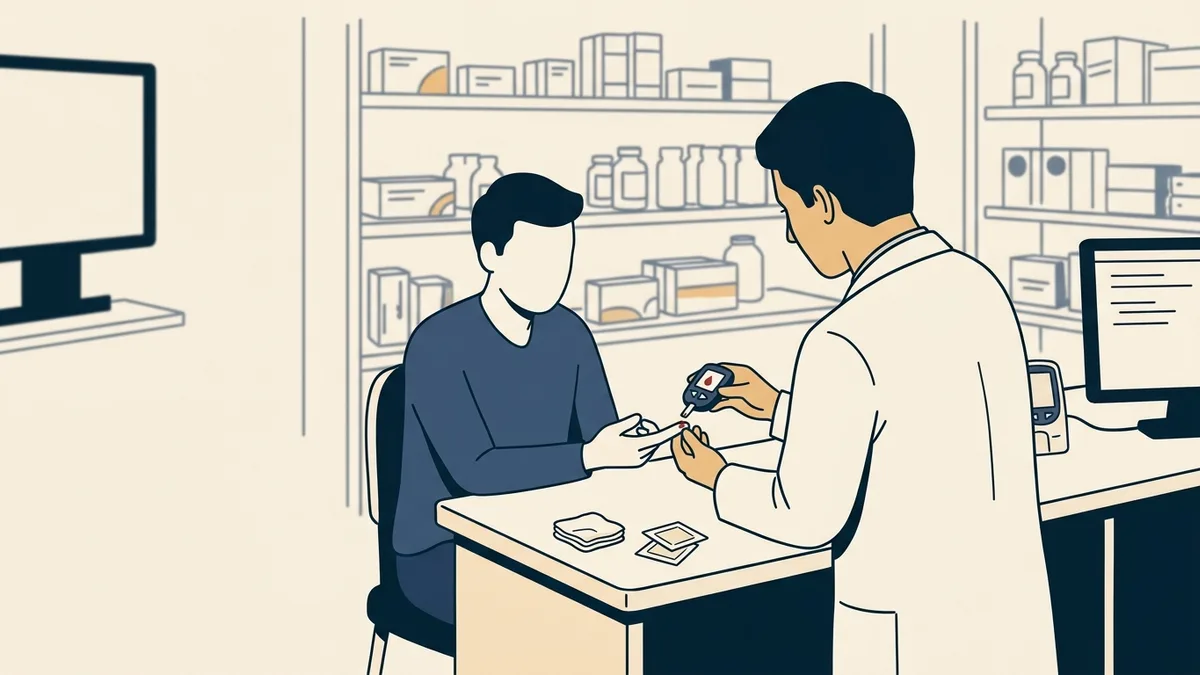
No. CMS's CMS-116 instructions say waived tests are not exempt from CLIA, and facilities performing only waived tests must apply for a Certificate of Waiver. The waiver removes the nonwaived quality standards, not the certificate, the fee, the manufacturer's instructions, the change notices or the possibility of inspection.
The word "waived" causes more CLIA trouble than any other. A practice buys a box of rapid strep tests, a pharmacy adds A1c screening, an employer sets up a testing table, and someone assumes a waived test needs no paperwork. The Form CMS-116 instructions answer that directly: "WAIVED TESTS ARE NOT EXEMPT FROM CLIA. FACILITIES PERFORMING ONLY THOSE TESTS CATEGORIZED AS WAIVED MUST APPLY FOR A CLIA CERTIFICATE OF WAIVER."
CDC's waived testing page says the same thing from the patient-safety side: United States lab facilities "are regulated under Clinical Laboratory Improvement Amendments of 1988 (CLIA), including waived tests."
So what does "waived" actually waive?
The quality standards built for nonwaived labs. The subparts of 42 CFR Part 493 on proficiency testing, facility administration, quality systems and personnel are titled "for Nonwaived Testing," and 493.20(c) says several of them are "not applicable to the waived tests." A waiver lab has no federal proficiency testing requirement, no federal qualifications for its director, and no routine biennial survey. That is a lighter load. It is not the absence of a certificate.
What does a waiver lab still owe?
- A certificate before testing. Under 42 CFR 493.3(a), a lab "will be cited as out of compliance" with the statute unless it holds a current certificate "applicable to the category of examinations or procedures performed."
- The CMS fee. $248 per two-year certificate as of October 2026, paid by the lab on pay.gov (493.37(c)).
- The manufacturer's instructions, every time. Waiver labs must "follow manufacturers' instructions for performing the test" (493.15(e)(1)). Use a kit off-label and CMS says it "defaults to high complexity," which a waiver lab cannot perform. See off-label use of waived tests.
- Notice before going further. The State Agency must hear before the lab performs any test that is not waived, and within 30 days of a change in ownership, name, location or director (493.39).
- Access for inspectors. Waiver labs must permit announced and unannounced inspections, including random ones "to determine whether the laboratory is performing tests not listed" as waived (493.35(d)(2)). See when a waiver lab gets inspected.
- Exposure to sanctions. Since January 27, 2024, CMS may impose alternative sanctions, including civil money penalties, on Certificate of Waiver labs (CMS-3326-F). See CLIA sanctions.
Why do payers care?
Medicare checks the certificate on the claim. CMS's MLN article on 2026's new waived tests explains: "We edit laboratory claims at the CLIA certificate level to ensure Medicare only pays for laboratory tests categorized as waived complexity under CLIA in facilities with a CLIA certificate of waiver." Medicaid can pay for lab services only when the lab has a CLIA certificate or a state license approved under CLIA (493.1809). A site that tests without a certificate is testing without a way to be paid for it. Our posts on putting the CLIA number on claims and the QW modifier cover the billing side.
When is no certificate needed?
The real exceptions are narrow, and none of them depends on the test being waived:
- Collection-only sites. "Facilities only collecting or preparing specimens (or both) or only serving as a mailing service and not performing testing are not considered laboratories" (493.2).
- Patient self-testing with a home-use test. CMS's home testing FAQ says an FDA home-use test "is not regulated under CLIA when that test is self-administered" according to its labeling. If staff perform it or interpret the result, "a CLIA certificate would be required." See home tests, self-testing and CLIA.
- Forensic, non-reporting research and SAMHSA drug testing (493.3(b)).
- New York and Washington. Both run CMS-approved state programs, New York only partly. Labs there follow state rules instead; see the New York and Washington pages.
What happens if a site has already started testing?
Stop and apply. Minnesota's CLIA State Agency answers the question in its FAQ: "you must cease testing until your fee has been paid" and CMS's receipt of payment is verified. The CMS-116's signature page carries a reminder of the stakes: anyone who intentionally violates CLIA "shall be imprisoned for not more than 1 year or fined," and up to 3 years for a repeat. The faster path is a complete application the first time; incomplete ones "will be returned to the facility."
The test being simple does not make the result unimportant, either. CDC notes that waived results such as prothrombin time and glucose are used to adjust anticoagulant and diabetes medication doses, and that waived tests "are not completely error-proof."
How do you get covered quickly?
White Glove CLIA prepares the CMS-116 and the waived test menu from your kits' instructions; the owner or director signs, and we can send the signed form to the State Agency. The lab then pays the CMS coupon on pay.gov. A Certificate of Waiver Application is $399 per site. The full process is in the Certificate of Waiver, start to finish, and the Certificate of Waiver hub covers waived testing in one place.
Common questions
- Do I need a CLIA certificate for a single waived test?
- Yes. The CMS-116 instructions say CLIA applies even if only one or a few basic tests are performed, and even if you are not charging for them. A Certificate of Waiver covers a site that runs only waived tests.
- Does a waiver lab have to do proficiency testing?
- Federal CLIA rules do not require proficiency testing for waived tests. The waiver lab must still follow each manufacturer's instructions, notify the State Agency of changes and allow inspections.
- Can a school nurse use a home COVID test on students without a certificate?
- Not if staff perform or interpret it. CMS's home testing FAQ says a facility such as a school, shelter or jail needs a CLIA certificate when a staff member performs the test or interprets the result, even with a home-use test.
- What happens if we started waived testing before getting a certificate?
- Stop testing and apply. Minnesota's State Agency, for example, says a site must cease testing until its fee is paid and CMS's receipt is verified. Under 42 CFR 493.3, a lab without a current certificate is out of compliance.
Need Help with Your CLIA Certificate?
We prepare your CMS-116 and any state filing for your owner or director to sign, then track your certificate, changes and renewals.