
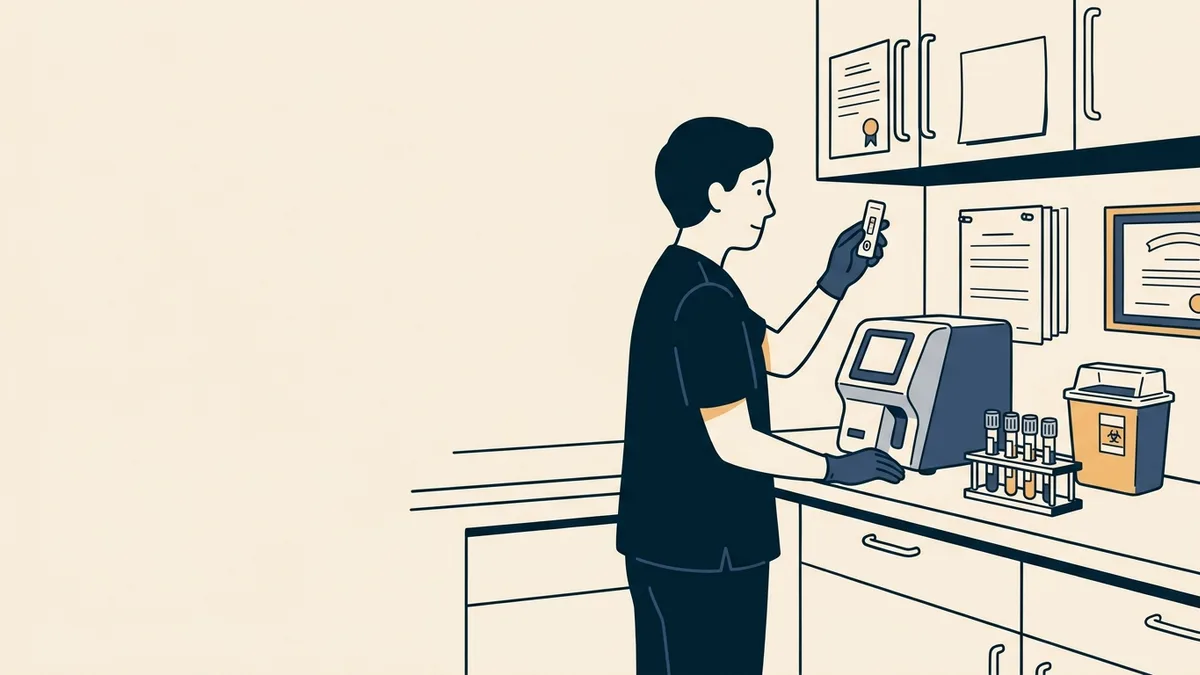
Every urgent care clinic that runs rapid strep, flu, COVID or urine tests is a CLIA laboratory and needs its own certificate. A for-profit group fits none of the multiple-site exceptions, so each clinic files a CMS-116, gets its own CLIA number and pays its own fee. Most clinics hold a Certificate of Waiver; clinics reading wet mounts need PPM.
Urgent care is built on point-of-care testing. A patient with a sore throat, a fever or burning on urination expects an answer before they leave, and that answer usually comes from a waived test run in a corner of the clinic. Every one of those clinics is a laboratory under CLIA, and each one needs its own certificate.
CLIA applies "even if only one or a few basic tests are performed, and even if you are not charging for testing," and "WAIVED TESTS ARE NOT EXEMPT FROM CLIA" (Form CMS-116 instructions). For a group of clinics the practical questions are which certificate each clinic needs, how to keep a dozen certificates current, and what to do when the group grows.
Does each clinic need its own CLIA certificate?
Yes. A laboratory performing only waived tests "must file a separate application for each laboratory location" (42 CFR 493.35(a)). The only ways to cover several sites with one certificate are mobile or temporary testing tied to a home base, limited public health testing by not-for-profit or government labs, and hospital labs on one campus. A for-profit urgent care group with fixed clinics fits none of them. Our post on the three multiple-site exceptions walks through each one and why chains fall outside.
That means one CMS-116, one CLIA number and one certificate fee per clinic. The current CMS fee for a Certificate of Waiver, as of October 2026, is $248 every two years, paid by each clinic's lab on pay.gov from its own emailed coupon.
Which certificate fits a typical urgent care clinic?
Most clinics run only waived tests and hold a Certificate of Waiver. The common menu shows up on Medicare's list of waived codes:
- Rapid strep A antigen, 87880QW, and molecular strep A on certain instruments, 87651QW
- Influenza A and B antigen, 87804QW, and molecular flu, 87502QW
- COVID-19 plus influenza A and B antigen, 87812QW, new as a waived code on January 1, 2026 (CMS MLN MM14273)
- Dipstick urinalysis, 81002 (no QW needed) or 81003QW on an automated waived reader
- Visual urine pregnancy test, 81025 (no QW needed)
- Mono screen, 86308QW
Codes are only a billing label. What matters for CLIA is the specific test system, and the FDA's CLIA database is where you confirm that the exact kit you buy is categorized as waived. See how to tell whether a test is CLIA-waived.
A clinic whose physicians or nurse practitioners read wet mounts or KOH preps under the microscope needs a PPM certificate instead. PPM procedures must be "personally performed" by a physician, a midlevel practitioner (supervised, or independent where the state allows) or another practitioner the rule names, "during the patient's visit" (42 CFR 493.19(b)). The PPM certificate also covers waived tests, but it brings nonwaived quality rules and a qualified director. The current CMS fee for PPM, as of October 2026, is $297. Read the PPM certificate and the nine microscopy procedures before you choose it.
Who should be the laboratory director at each clinic?
For a Certificate of Waiver, federal rules set no director qualifications; the CMS-116 asks only the director's name, phone number and credentials. Many groups name the clinic's medical director. For PPM, the director must be a physician, a midlevel practitioner authorized by the state to practice independently, or another practitioner listed in 42 CFR 493.1357, and the CMS-116 instructions say that for PPM, Compliance or Accreditation certificates "an individual can only serve as the director for no more than five certificates." That cap is the one that bites growing groups. A regional medical director over eight clinics cannot be the PPM director for all eight. See the five-lab limit for CLIA directors.
Section X of the CMS-116 asks you to list every other lab the director directs, including waiver labs. Keep that list accurate across the group, because each clinic's form is reviewed on its own.
What goes on the CMS-116 for an urgent care clinic?
Section III has 29 facility types, and none of them is "urgent care." Choose the one "most descriptive of the location where the laboratory testing is performed," and ask your State Agency if none fits; the Quick Start Guide tells applicants to "Contact your State Agency with questions." Other fields to get right:
- Physical address. The clinic's street address, which "cannot be a Post Office box or Mail Stop."
- Email address. Since March 1, 2026, "CMS will send all fee coupons and CLIA certificates by email." Use a shared inbox the group controls, not a departing manager's address.
- Hours of testing. The times testing actually happens, in HH:MM format, or the 24/7 box.
- Waived test table. Every analyte, test name and manufacturer, plus the estimated total annual volume.
The owner or director of each clinic's lab reviews and signs its own form, and the signed form goes to the State Agency for the state where the clinic sits. Our section-by-section CMS-116 guide covers the rest.
What changes when you open, buy or close a clinic?
- Opening a clinic. A new location is a new initial application. CMS says labs "are generally required to have the appropriate certificate before they can begin testing," so file early enough that the new clinic is not swabbing patients without a CLIA number.
- Buying a clinic. Notify the State Agency within 30 days of a change in ownership (42 CFR 493.39(b)). CMS keeps the lab's existing number: "Once a laboratory is assigned a number, it retains this number even if it... changes its certificate type or ownership" (State Operations Manual, Chapter 6, section 6008). Payer files are a separate job; see moving, renaming or selling a CLIA lab.
- Changing the director or name. Also 30 days. A revised certificate costs $95 for a waiver or PPM lab, as of October 2026.
- Adding a nonwaived test. A waiver or PPM clinic must notify the State Agency before testing beyond its certificate (493.39(a)); the Quick Start Guide says "immediately." See adding tests to your menu.
- Closing a clinic. Tell the State Agency; the CMS-116 instructions list "lab closure" among the changes reported with an effective date.
Who receives the fee coupons for each clinic?
Whoever owns the email address on that clinic's CMS-116. The Quick Start Guide says CMS sends "a Fee Coupon via email" carrying the clinic's "unique 10-character alphanumeric CLIA Identification Number" and the total due, and that the fee is paid "on pay.gov" by bank account, debit or credit card. Waiver and PPM labs "will receive a renewal invoice 6 months before their certificate expires." With a dozen clinics, that is a dozen coupons arriving on a dozen schedules.
CMS's tip is to "Include a business email address that many laboratory staff access and use." CMS's October 7, 2026 alert adds two steps for every lab: "Share this alert with your laboratory's billing, compliance, and administrative staff" and "Verify your laboratory's email address is current with CMS," because third-party mailings "styled as bills or invoices" were reaching labs. See email-only fee coupons.
Where do state rules add a second filing?
Opening a testing site in another state can add a state lab registration or license on top of CLIA. A few examples we see with urgent care groups:
- California requires every lab doing waived or PPM testing to register with the state, with "a separate license or registration... for each laboratory location" (Bus. & Prof. Code 1265). See California.
- Pennsylvania exempts a practitioner's office only when it performs a short list of procedures, such as dipstick urinalysis and pregnancy tests (28 Pa. Code 5.1). Rapid strep and flu antigen tests are not on that list. See Pennsylvania.
- Washington runs its own Medical Test Site license in place of CLIA, so clinics there do not file a CMS-116 at all. See Washington.
Check every state on the state requirements index before the lease is signed.
How do we price an urgent care rollout?
We build one CMS-116 per clinic from your shared menu, adjust each for its director, hours and volume, and add any state registration. Your owner or each clinic's director signs; CMS bills each lab directly by email. Our Multi-Site Waiver Package is $1,599 for five clinics, and groups of 10 or more pay $249 per clinic. State registrations are $299 per state, and changes after approval are $149 each. Renewal and Compliance Tracking ($299 per year for the first lab, $99 per year for each added clinic) watches every expiration date and 30-day notice. For the claims side, White Glove Medical Billing has a post on urgent care billing and payer mix.
Common questions
- Can one CLIA number cover all our urgent care clinics?
- No. A separate application is required for each fixed testing location, and a for-profit urgent care group fits none of the three exceptions in 42 CFR 493.35(b).
- Does a waiver lab director need lab qualifications?
- Federal rules set no director qualifications for a Certificate of Waiver. The CMS-116 still asks for the director's name and credentials, and some states add their own requirements.
- How fast do we have to report a new medical director?
- Within 30 days of the change, for every certificate type (42 CFR 493.39 for waiver labs). A revised certificate costs $95 for a waiver or PPM lab as of October 2026.
- Do we need a new CLIA number when we buy a clinic?
- Usually not. CMS says a lab keeps its number when ownership changes. The change must be reported to the State Agency within 30 days, and payer files need updating separately.
Need Help with Your CLIA Certificate?
We prepare your CMS-116 and any state filing for your owner or director to sign, then track your certificate, changes and renewals.